
Before You Buy Research Peptides: 8 Things to Check
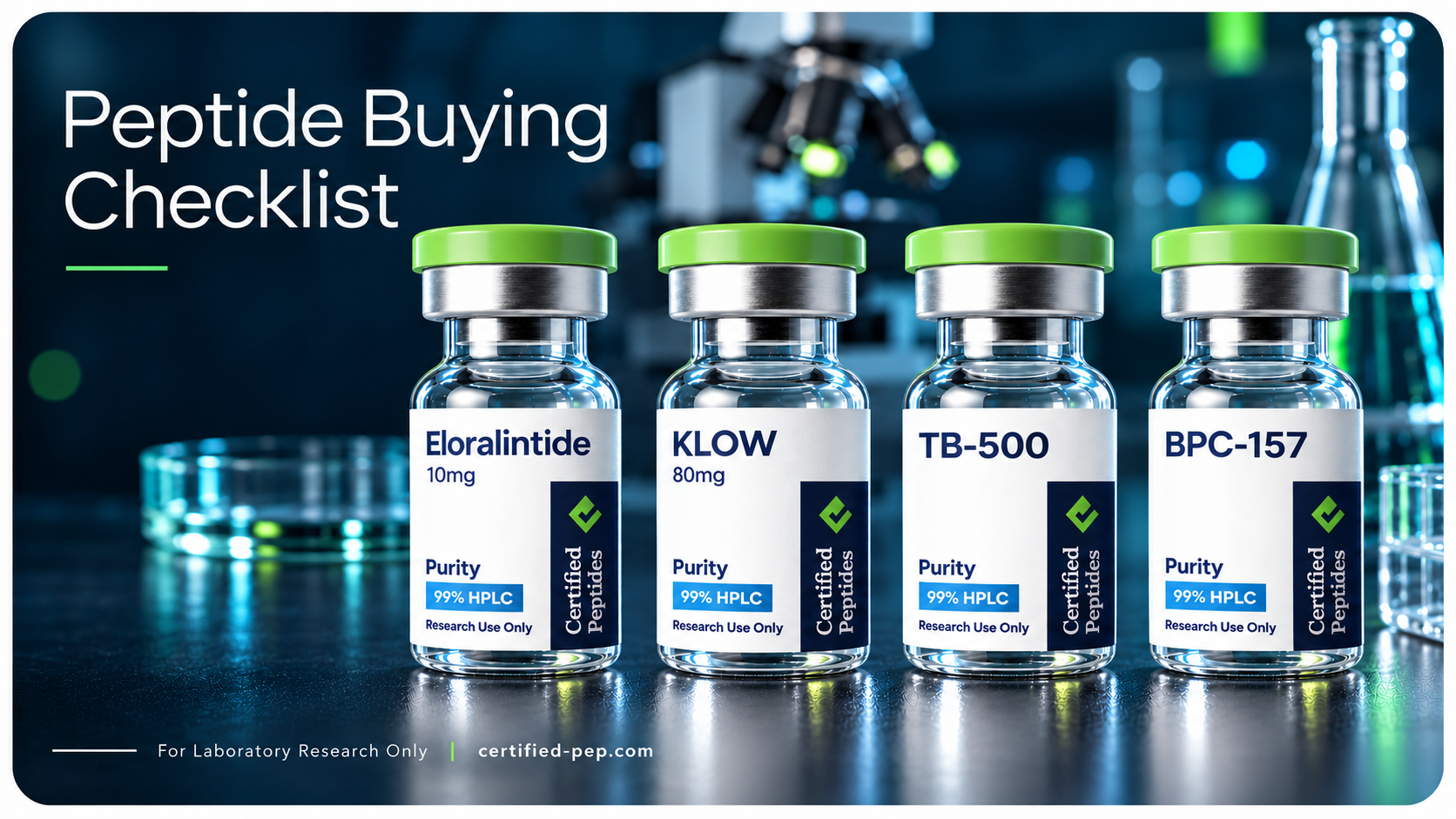
A product listing can tell you what a vendor says it sells. Testing records and batch documentation help you assess what was tested and whether the report matches the lot you are reviewing.
Use this checklist to compare vendors and product records. No single badge, purity number, or certificate establishes every aspect of a material’s identity or quality.
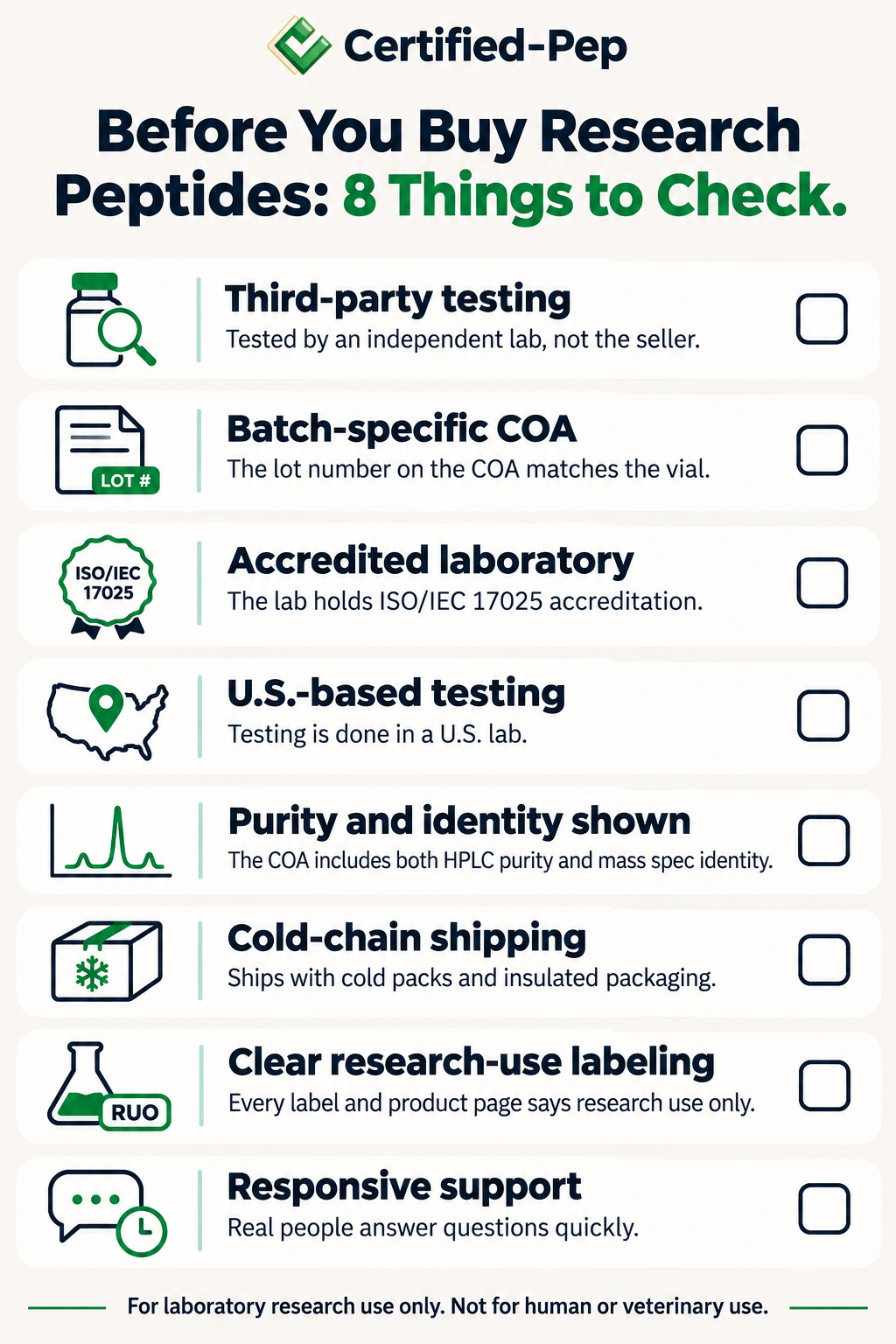
1. Look for third-party testing
Check whether an independent laboratory performed the testing. A useful report identifies the lab and the material tested, and gives results you can review. A seller’s “tested” badge is not a substitute for the underlying report.
2. Match the COA to the batch
A certificate of analysis (COA) should be specific to a batch or lot. Match the lot number on the report to the number on the vial or product documentation. Also check that the compound name, test date, methods, and reported results are clear. A report for a different lot may not describe the material you receive.
3. Verify the laboratory’s accreditation
ISO/IEC 17025 is an international standard for testing and calibration laboratory competence, impartiality, and consistent operation. Accreditation applies to a defined scope of work, so check that the lab’s scope covers the relevant testing activity; accreditation is not a blanket claim about every test the lab performs. (ISO overview, International Accreditation Service scope guidance)
4. Confirm where testing took place
A U.S. mailing address, shipping origin, or “Made in USA” statement does not by itself show where a sample was tested. Look for the testing laboratory’s name and location on the report, then confirm that the location matches the vendor’s description.
5. Review purity and identity data
For peptide materials, chromatography such as HPLC can help assess a sample’s purity profile, while mass spectrometry can support identity assessment. These methods answer different questions; a purity percentage alone does not establish that the material is the intended compound. The United States Pharmacopeia’s discussion of synthetic peptide reference standards describes using chromatography and mass spectrometry among complementary analytical methods. (USP article indexed by PubMed)
6. Ask how shipping is handled
Check whether the vendor uses insulated packaging and cold packs, and whether those shipping conditions match the product’s stated handling requirements. Requirements can depend on the material and its form, so look for clear handling information rather than assuming every product has identical storage needs.
7. Check for clear research-use labeling
The product page and the package label should consistently identify the material as intended for laboratory research use only. They should not present it as a product for human or veterinary use. Read the disclaimer before placing an order.
8. Test the support before you need it
Ask a specific question about the COA, lot number, test methods, accreditation scope, or shipping conditions. A responsive support team should be able to direct you to the relevant documentation or explain where to find it. Clear answers make it easier to evaluate the records; they do not replace the records themselves.
Product pages to review
These catalog pages can serve as starting points for reviewing product information and batch documentation: Eloralintide, Wolverine Stack (BPC-157 / TB-500), NAD+, KLOW, ATX-304, SLU-PP-332, and 5-Amino-1MQ.
Review the batch-specific documentation for the lot you are considering; a catalog page is not a substitute for a lot-matched report.
For laboratory research use only. Not for human or veterinary use.