
Description
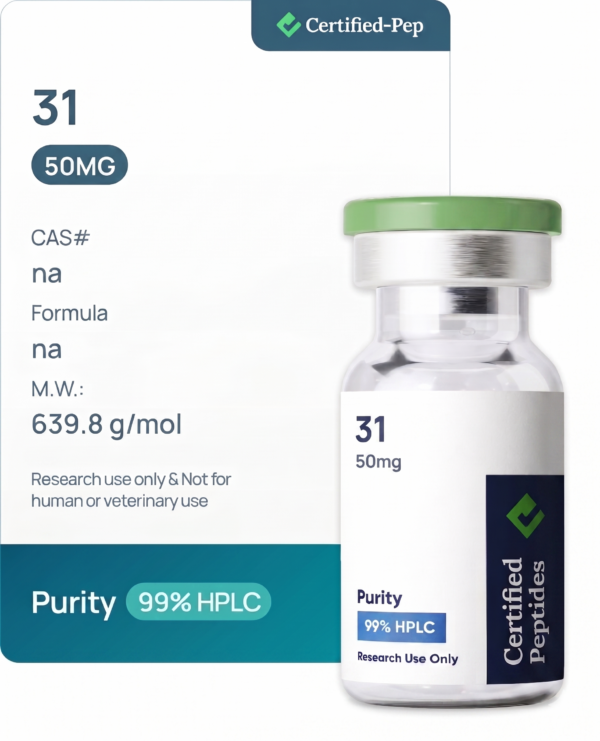
| Wolverine Stack – BPC-157 TB-500 10mg/10mg | |
|---|---|
| SKU | CP_BPC_157_TB_500_10_10MG_3ML_VIAL |
| CATEGORY | Research Compounds |
| CAS | N/A |
| VIAL SIZE | 3 mL |
| FORM | LYOPHILIZED POWDER |
| MOLECULAR WEIGHT | N/A |
| COMPOSITION | N/A |
| MOLECULAR FORMULA | N/A |
| ITEM ID | 31186 |
Individual Component Data:
- BPC-157 — CAS# 137525-51-0; Formula: C62H98N16O22; Mol. Wt.: 1419.53 g/mol; Sequence: Gly-Glu-Pro-Pro-Pro-Gly-Lys-Pro-Ala-Asp-Asp-Ala-Gly-Leu-Val
- TB-500 — CAS# 77591-33-4; Formula: C212H350N56O78S; Mol. Wt.: 4963.44 g/mol; Sequence: SDKPDMAEIEKFDKSKLKKTETQEKNPLPSKETIEQEKQAGES (43 aa; LKKTET actin-binding motif, residues 17-22)
This blend provides BPC-157, TB-500 as lyophilized powder in a single vial.
BPC-157 — CAS N/A. Achilles tendon repair in rats: Staresinic et al.
TB-500 — CAS N/A. Achilles tendon repair in rats: Staresinic et al.
Buy the Wolverine Stack: BPC-157 and TB-500 in one vial
BPC-157 and TB-500 are two synthetic peptides studied in tissue repair models, and the pairing is widely known as the Wolverine stack.
BPC-157 is a 15-residue sequence taken from a gastric protein. TB-500, as supplied here, is the 43-residue sequence of thymosin beta-4, an actin-binding protein. The two act through different pathways: BPC-157 on angiogenic and growth factor signaling, TB-500 on actin dynamics and cell migration. This BPC 157 TB 500 blend contains 10 mg of each peptide in a single blended vial, lyophilized for laboratory research use.
Both compounds are research peptides with no FDA approval for human use. Everything below comes from cell cultures, rats and other animal models.
BPC-157, the body protection compound
BPC-157 is a synthetic chain of 15 amino acids (Gly-Glu-Pro-Pro-Pro-Gly-Lys-Pro-Ala-Asp-Asp-Ala-Gly-Leu-Val). Its sequence comes from body protection compound, a protein first described in human gastric juice. That origin is why early work on it focused on gastric protection and gut health in rats [1]. You can also order it on its own as BPC 157 10 MG.
Its primary mechanism is still being mapped. In rat and cell studies, BPC-157 raised growth hormone receptor expression in tendon fibroblasts [4]. It also activated VEGFR2, a receptor that drives the growth of new blood vessels [6]. In a rat hind limb model with blocked arteries, that VEGFR2 activity came with faster recovery of blood flow [6].
TB-500 and cell migration
TB-500 is sold here as the 43-amino-acid sequence of thymosin beta-4 (Tβ4), a protein found in most cells of the human body. Its LKKTET motif binds actin, the protein cells use to crawl. That makes cell migration the main thing researchers study it for [9]. In a rat model of full-thickness skin wounds, Tβ4 sped up wound closure, and treated wounds showed more collagen and more blood vessels than controls. In cell culture it increased keratinocyte migration [7]. A single-peptide version is listed as TB-500 10 MG.
Why researchers study them as a peptide stack
The two peptides touch tissue repair at different points. BPC-157 acts on blood vessels and growth factor signaling. TB-500 acts on actin and the movement of cells into damaged tissues. Both act on parts of the body’s natural healing processes. Researchers use them to study tissue regeneration, and they pair them to see whether two routes add up in one model. The studies below tested each peptide alone, so any combined effect of the Wolverine peptide stack is untested. The blend is also part of larger mixes such as GLOW 70MG, KLOW 80MG and the BPC-157 / TB-500 / Cartalax vial.
Potential benefits and inflammation control in animal models
These are the findings people mean when they talk about potential benefits. All come from preclinical models.
Staresinic et al. (2003) cut the Achilles tendon in rats. BPC-157 improved biomechanical, functional and microscopic measures of healing, and in vitro it stimulated tendon cell growth [2]. Chang et al. (2011) found that in rat tendon explants it increased cell outgrowth, cell survival under oxidative stress and cell migration [3]. Cerovecki et al. (2010) reported better ligament healing after a rat knee ligament was cut [5]. Rat work on muscle repair and muscle recovery after injury points the same way. Reviews also describe effects on inflammation control and the immune system in these models [1].
Those results explain the search interest in injury recovery, wound healing and regenerative medicine. They do not show that either peptide can accelerate healing or support healing in people. Rat studies also mixed delivery routes, from a local injection site near the injury to systemic dosing, so localized healing and whole-body effects are hard to separate.
Chronic pain and chronic knee pain: what the data do not cover
A lot of search traffic for this stack is about chronic pain, joint pain and chronic knee pain. None of the studies above measured pain in people. No controlled human trials have tested either peptide for knee or joint pain, or against physical therapy. Claims that the blend can reduce pain or reduce inflammation in people have no clinical evidence behind them.
Regulatory status: not FDA approved and not a peptide therapy
Their regulatory status is simple. Neither BPC-157 nor TB-500 has FDA approval, and no product sold as a Wolverine stack is FDA approved. Thymosin beta-4 formulations have entered early human trials for eye and skin wounds [9]. There is still no human clinical data for this blend or for TB-500 as sold by research suppliers. This page doesn’t describe a peptide therapy protocol and makes no claims about health and wellness goals. Questions about personal health need medical guidance from a qualified healthcare professional, so ask a qualified medical professional rather than a research supplier. Medical professionals prioritize patient safety by working from approved products, completed clinical trials and medical supervision. Research chemicals have none of those.
Health risks and open questions
The health risks of these compounds in humans are unknown. Human trials have not been completed, and the safety data that exist come from animal studies. A 2022 study tracked how BPC-157 is absorbed, distributed and cleared in rats and dogs [8]. How either peptide behaves in people over time hasn’t been studied. Researchers should also note that animal models used different doses, routes and schedules, so results don’t transfer neatly from one study to the next.
Quality testing
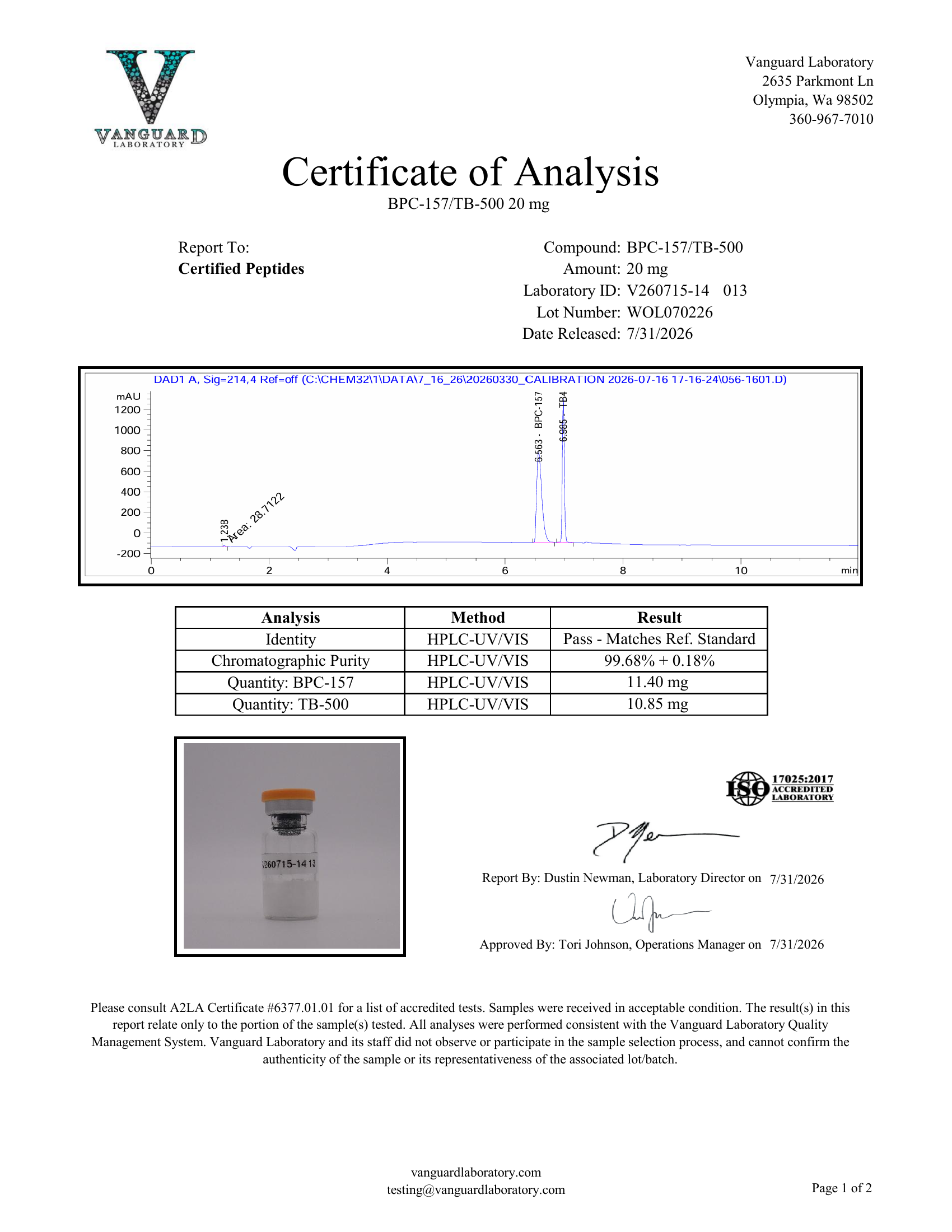
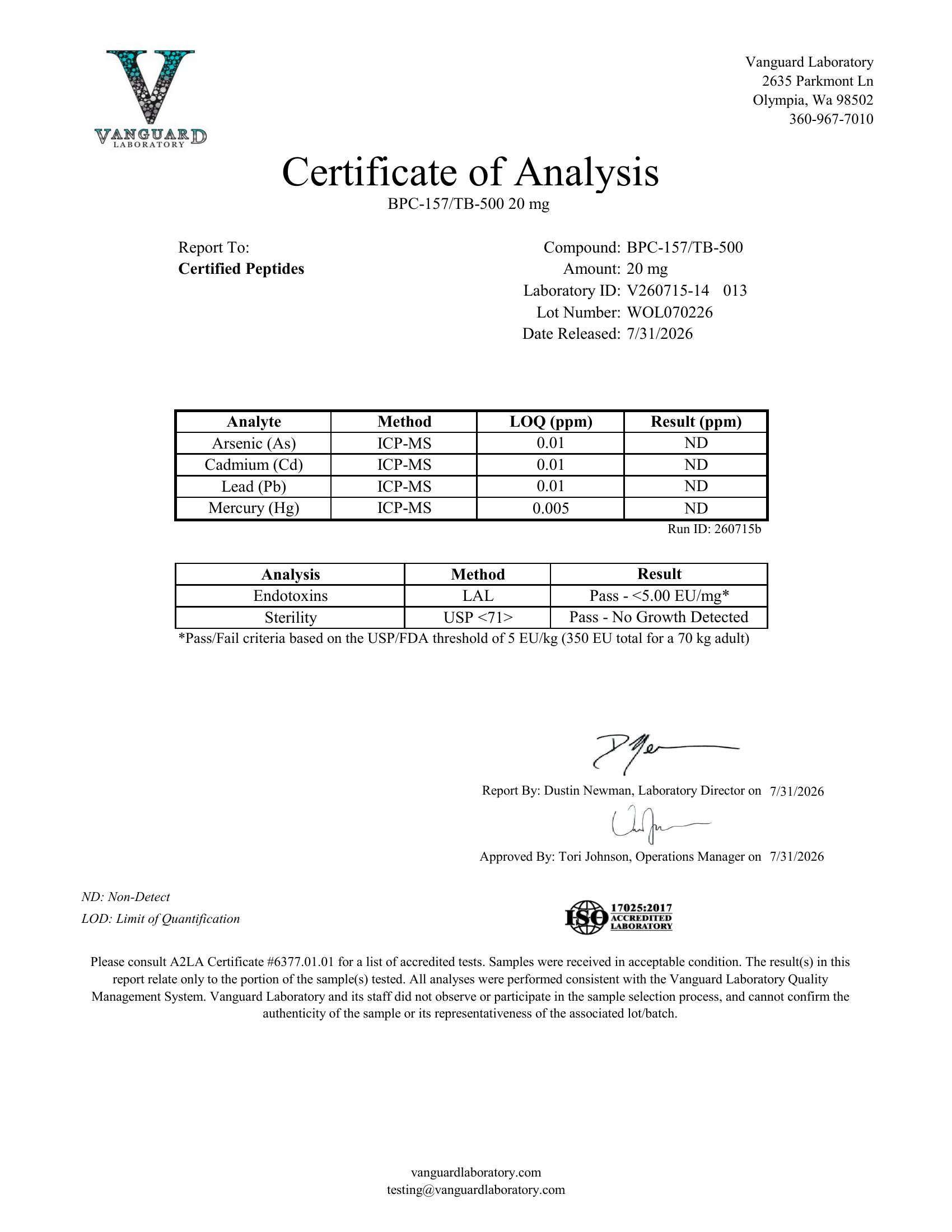
Certified Peptides manufactures in a cGMP facility in Texas (made in the USA). Every batch goes through rigorous testing at an ISO/IEC 17025 accredited US laboratory, an independent laboratory. The panel runs HPLC for purity, LC-MS for identity, LAL for endotoxins, ICP-MS for heavy metals and USP <71> for sterility. Batches typically test at 99%+ purity by HPLC. Researchers who buy the Wolverine stack online from us get both peptides from one lot, so one record covers the vial. Each vial carries a QR code tied to its lot, so you can pull its own lot matched certificate from our COA Library. See Lab Testing for the full panel.
Handling and storage
Keep vials sealed, cold and away from light. Lyophilized peptides hold up better than solutions, and the COA lists storage notes for each lot.
Questions researchers ask
Is the Wolverine stack FDA approved? No. Neither peptide has FDA approval, and the blend is sold for laboratory research use only.
Why choose Wolverine stack peptides in a single blended vial instead of separate vials? One lot and one lot matched certificate cover both peptides, which simplifies records. The Wolverine stack cost is shown at the top of this page.
How do these peptides affect tissue? In animal models, BPC-157 acts on blood vessel growth and growth hormone receptors, and TB-500 acts on actin and cell movement. How the two peptides affect tissue together hasn’t been tested.
Is there an oral version? The catalog lists BPC-157 / TB-500 capsules for research. Read Research Purposes Only? and our FAQ before you order.
Disclaimer
For laboratory research use only. Not for human or veterinary use. Not for consumption. This product is not a drug, food or cosmetic. Information on this page is for educational purposes, has not been evaluated by the FDA, and is not intended to diagnose, treat, cure or prevent any disease.
References
- Józwiak M, Bauer M, Kamysz W, Kleczkowska P. “Multifunctionality and Possible Medical Application of the BPC 157 Peptide: Literature and Patent Review.” Pharmaceuticals. 2025;18(2):185. doi:10.3390/ph18020185
- Staresinic M et al. “Gastric pentadecapeptide BPC 157 accelerates healing of transected rat Achilles tendon and in vitro stimulates tendocytes growth.” J Orthop Res. 2003;21(6):976-983. doi:10.1016/S0736-0266(03)00110-4
- Chang C-H, Tsai W-C, Lin M-S, Hsu Y-H, Pang J-H S. “The promoting effect of pentadecapeptide BPC 157 on tendon healing involves tendon outgrowth, cell survival, and cell migration.” J Appl Physiol. 2011;110(3):774-780. doi:10.1152/japplphysiol.00945.2010
- Chang C-H, Tsai W-C, Hsu Y-H, Pang J-H S. “Pentadecapeptide BPC 157 enhances the growth hormone receptor expression in tendon fibroblasts.” Molecules. 2014;19(11):19066-19077. doi:10.3390/molecules191119066
- Cerovecki T et al. “Pentadecapeptide BPC 157 (PL 14736) improves ligament healing in the rat.” J Orthop Res. 2010;28(9):1155-1161. PubMed 20225319
- Hsieh M-J et al. “Therapeutic potential of pro-angiogenic BPC157 is associated with VEGFR2 activation and up-regulation.” J Mol Med. 2017;95(3):323-333. PubMed 27847966
- Malinda KM et al. “Thymosin beta4 accelerates wound healing.” J Invest Dermatol. 1999;113(3):364-368. PubMed 10469335
- He L et al. “Pharmacokinetics, distribution, metabolism, and excretion of body-protective compound 157, a potential drug for treating various wounds, in rats and dogs.” Front Pharmacol. 2022;13:1026182. doi:10.3389/fphar.2022.1026182
- Xing Y, Ye Y, Zuo H, Li Y. “Progress on the Function and Application of Thymosin β4.” Front Endocrinol. 2021;12:767785. doi:10.3389/fendo.2021.767785
Tags: synthetic peptide derived, therapeutic peptides, adequate protein intake, tissue healing, blood vessel formation, injection site reactions, immune function, connective tissue, muscle preservation, faster healing, peptide protocol, systemic inflammation, post surgical patients, typically administered, injury site, collagen production, control group, serving patients, ligament injuries, systematic review, improved mobility, serious risks, regulatory considerations, legal status, cellular level, synthetic fragment
injury recovery
Wolverine Stack is administered via subcutaneous injection.
Cycling schedules are important to prevent receptor desensitization.
Peptides are often administered in cycles aligned with recovery goals.
Users report mild side effects like headaches and injection-site irritation.
Reported side effects include injection site reactions and fatigue.
Legal status
BPC-157 is prohibited under WADA’s S0 Unapproved Substances category.
TB-500 promotes systemic tissue turnover and reduces inflammation.
Patients report improved mobility and reduced pain with the stack.