
Description
| KLOW 80MG | |
|---|---|
| SKU | CP_KLOW_80MG_3ML_VIAL |
| CATEGORY | Research Compound |
| CAS | BPC-157: 137525-51-0 GHK-CU: 89030-95-5 TB-500: 77591-33-4 KPV: 112965-21-6 |
| VIAL SIZE | 3 mL |
| FORM | LYOPHILIZED POWDER |
| MOLECULAR WEIGHT | N/A |
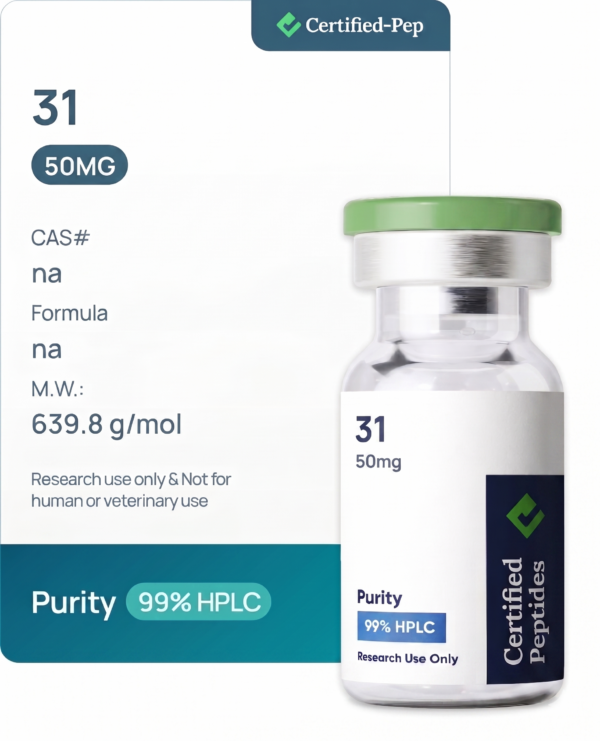
| COMPOSITION | GHK-Cu 50 mg + BPC-157 10 mg + TB-500 10 mg + KPV 10 mg |
| MOLECULAR FORMULA | N/A |
| ITEM ID | 8855 |
Individual Component Data:
- GHK-Cu — CAS# 89030-95-5; Formula: C14H24CuN6O4; Mol. Wt.: 403.9 g/mol; Sequence: Gly-His-Lys coordinated to Cu(II)
- BPC-157 — CAS# 137525-51-0; Formula: C62H98N16O22; Mol. Wt.: 1419.53 g/mol; Sequence: Gly-Glu-Pro-Pro-Pro-Gly-Lys-Pro-Ala-Asp-Asp-Ala-Gly-Leu-Val
- TB-500 — CAS# 77591-33-4; Formula: C212H350N56O78S; Mol. Wt.: 4963.44 g/mol; Sequence: SDKPDMAEIEKFDKSKLKKTETQEKNPLPSKETIEQEKQAGES (43 aa; LKKTET actin-binding motif, residues 17-22)
- KPV — CAS# 67727-97-3; Formula: C16H30N4O4; Mol. Wt.: 342.43 g/mol; Sequence: Lys-Pro-Val (H-Lys-Pro-Val-OH)
KLOW 80MG is supplied as a lyophilized powder in a 3 mL vial. It is a multi-component product identified as KLOW peptide blend. Because a blend is not a single molecule, one CAS number, molecular weight, molecular formula, or peptide sequence does not apply to the finished mixture.
KLOW 80mg Research Blend: GHK-Cu, BPC-157, TB-500 and KPV
KLOW 80mg is a lyophilized research blend in a 3 mL vial. It combines four peptides: GHK-Cu 50 mg, BPC-157 10 mg, TB-500 10 mg and KPV 10 mg. Each of the four shows up in nonclinical work on tissue remodeling, cellular signaling and inflammation, and the blend puts them in a single vial for researchers who want to study them together. Every batch is made in the USA, ships with a certificate of analysis (COA) and is supplied at 99% HPLC purity for laboratory research use only.
KLOW 80mg: four peptides in one research blend
- GHK-Cu (50 mg) is the copper complex of the tripeptide Gly-His-Lys. Labs use it in collagen and extracellular matrix experiments, including skin cell models.
- BPC-157 (10 mg, CAS 137525-51-0) is a synthetic 15-amino-acid peptide. Its name comes from body protective compound, a protein first described in gastric juice.
- TB-500 (10 mg, CAS 77591-33-4) is listed here as a 43-amino-acid N-acetylated peptide, and the name TB-500 is a vendor designation.
- KPV (10 mg) is the tripeptide Lys-Pro-Val, which matches the C-terminal end of alpha-MSH.
Because a blend is not a single molecule, no single CAS number, molecular weight or formula describes the finished mixture. The specification table lists the blend composition, and the COA for your batch documents what was tested.
Laboratory research uses for the KLOW components
Maquart et al. (1988) exposed fibroblast cultures to GHK-Cu and measured collagen synthesis, which rose under the tested conditions [1]. In a later rat wound-chamber model, Maquart et al. (1993) found that collagen and glycosaminoglycans accumulated at the wound site [2]. More recent papers mostly test GHK-Cu inside larger formulations such as hydrogels, so their results cannot be pinned on GHK-Cu alone.
Biçer et al. (2026) tested BPC-157 and TB-500 in a rat model of Achilles tendon transection and repair. They scored tendons by load-to-failure testing, histology and collagen type I and III staining. Histopathological scores in the BPC-157 group differed numerically from controls, but total scores did not reach statistical significance. Collagen distribution under Sirius red birefringence was altered. The authors called the results preliminary [3]. Chang et al. (2011) looked at BPC-157 in tendon explants and tendon-derived cells and reported effects on outgrowth, cell survival and migration [4].
For KPV, Sung et al. (2025) exposed human HaCaT keratinocytes to fine particulate matter and found that KPV attenuated reactive oxygen species production and changed ERK, p38 and NF-κB signaling. They carried the observations into a three-dimensional reconstructed skin model [5]. Dalmasso et al. (2008) studied KPV uptake through the peptide transporter PepT1 and tested experimental intestinal inflammation in mice, where inflammatory responses fell [6].
Research use only: what the evidence covers and what it does not
No published study of this four-component combination is cited here. Each result above comes from one compound in its own model, so the findings do not show how the four behave when paired in one solution, whether they stay compatible, or whether they interact. Teams that add a solvent for reconstitution should confirm compatibility against their own protocol and read the methods sections of the original papers.
Safety also needs plain wording. None of these compounds is approved by the FDA for human use, and the safety profile of the research material has not been established. This page gives no dosing guidance, because KLOW is intended for laboratory research and not for people.
Handling, storage and quality
Keep vials sealed in a cool, dry place away from light and follow the storage notes on the batch documentation. Treat the blend as a laboratory chemical, use appropriate protective equipment, and consult your institution’s safety officer before handling it.
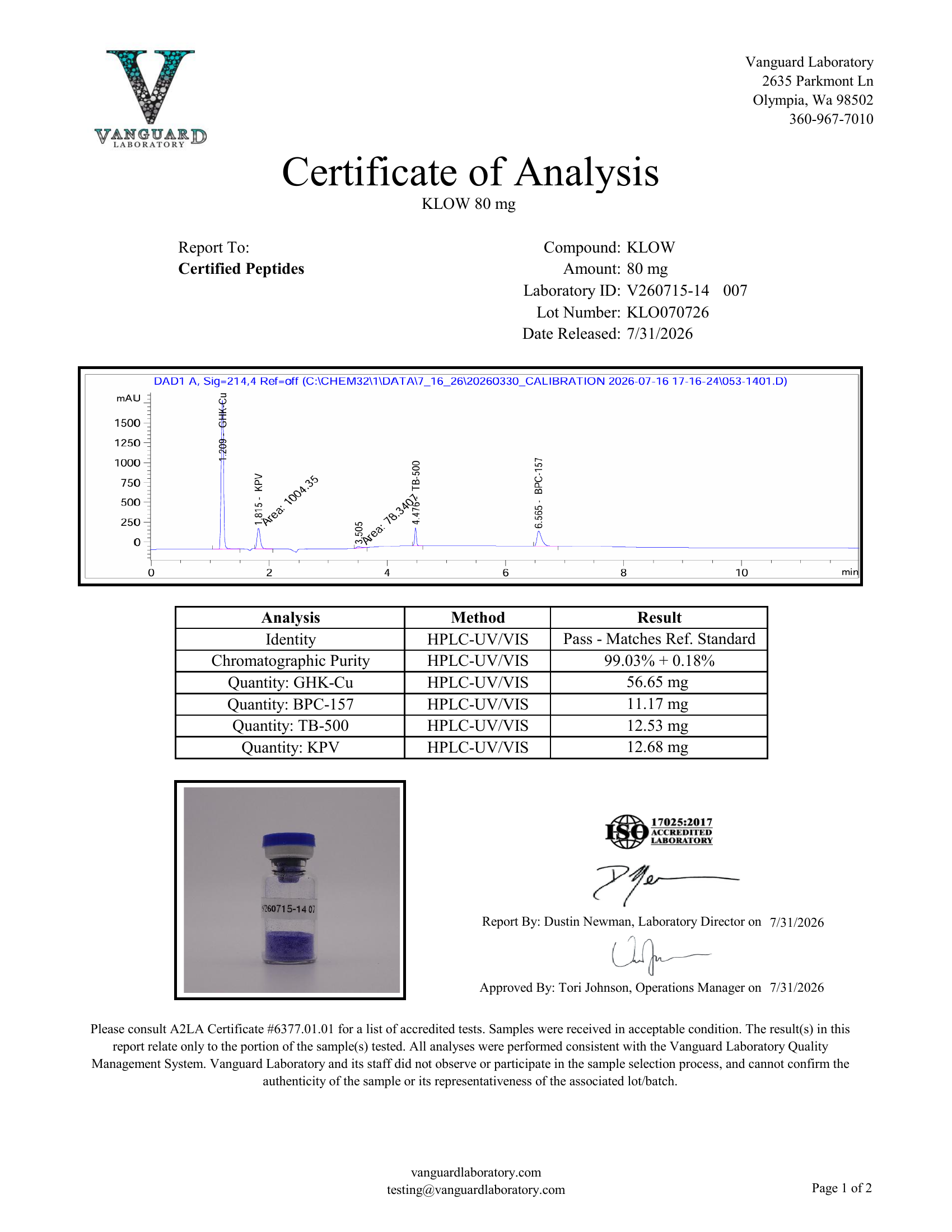
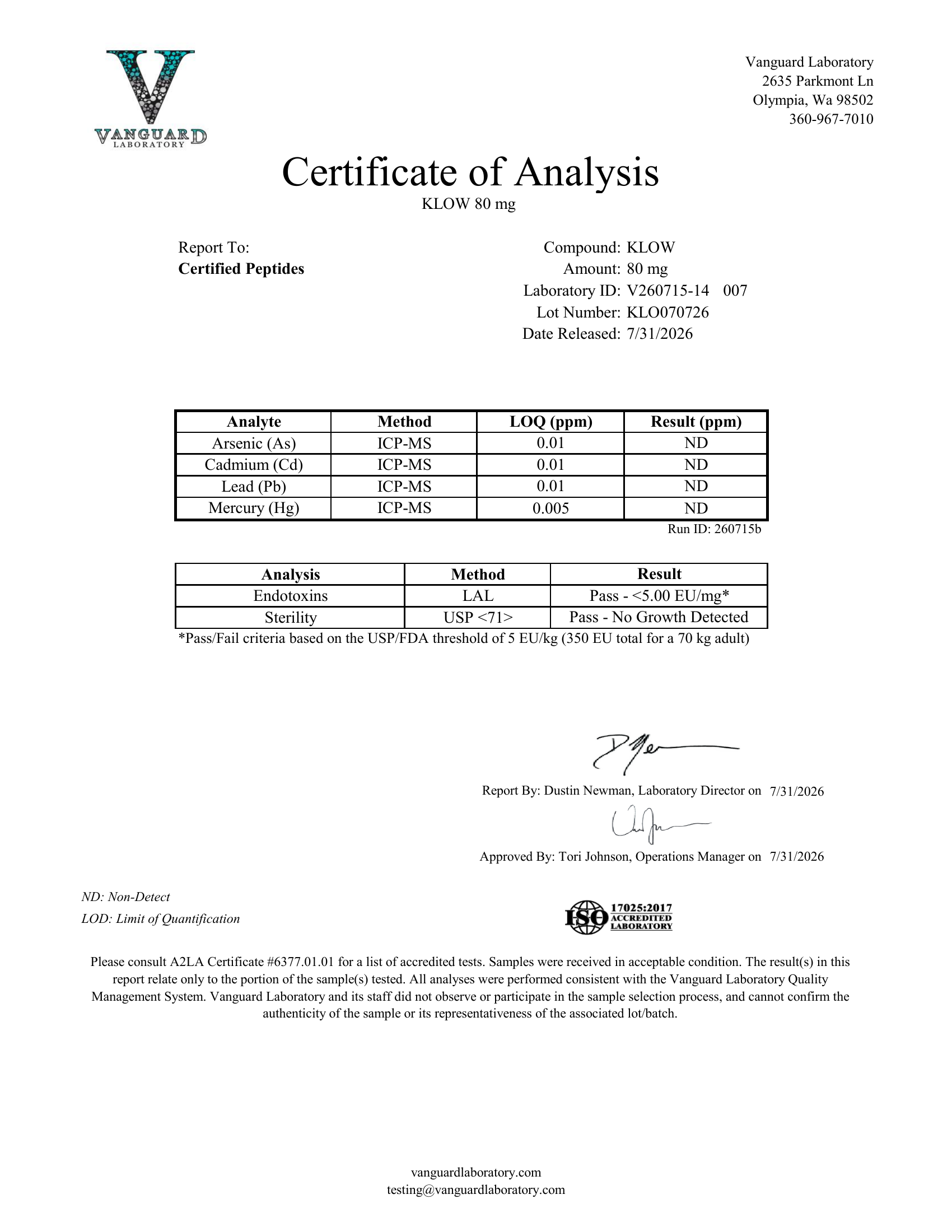
Certified Peptides only sells U.S.-made peptides and products. Each batch is tested at an accredited U.S. laboratory for identity, content and purity, with endotoxin, heavy metals and sterility screening, and every product carries a COA. Match the batch number on your vial to its certificate each time you reorder, since a later order can come from a different batch.
KLOW questions from researchers
Is KLOW 80mg for human consumption?
No. It is sold for laboratory research use only and is not for human or veterinary use.
What does each vial contain?
GHK-Cu 50 mg, BPC-157 10 mg, TB-500 10 mg and KPV 10 mg, supplied as a lyophilized powder in a 3 mL vial.
Is there a COA?
Yes. Every batch is tested for identity, content and purity, and the certificate of analysis documents the result.
References
1. Maquart FX, et al. (1988). Stimulation of collagen synthesis in fibroblast cultures by the tripeptide-copper complex glycyl-L-histidyl-L-lysine-Cu2+. FEBS Letters. 238(2):343-346. PMID: 3169264
2. Maquart FX, et al. (1993). In vivo stimulation of connective tissue accumulation by the tripeptide-copper complex glycyl-L-histidyl-L-lysine-Cu2+ in rat experimental wounds. Journal of Clinical Investigation. 92(5):2368-2376. PMID: 8227353
3. Biçer O et al. (2026). Effects of BPC-157 and TB-500 on Achilles tendon healing in rats. Joint Dis Relat Surg. PMID: 42542926
4. Chang CH, Tsai WC, Lin MS, Hsu YH, Pang JHS. (2011). The promoting effect of pentadecapeptide BPC 157 on tendon healing involves tendon outgrowth, cell survival, and cell migration. Journal of Applied Physiology. 110(3):774-780. PMID: 21030672
5. Sung J, Ju SY, Park S, et al. (2025). Lysine-Proline-Valine peptide mitigates fine dust-induced keratinocyte apoptosis and inflammation by regulating oxidative stress and modulating the MAPK/NF-κB pathway. Tissue & Cell. PMID: 40073467
6. Dalmasso G, et al. (2008). PepT1-mediated tripeptide KPV uptake reduces intestinal inflammation. Gastroenterology. PMID: 18061177
For laboratory research use only. Not for human or veterinary use. Not for human consumption. This product is not a drug, food or cosmetic. Information on this page is for educational purposes, has not been evaluated by the FDA, and is not intended to diagnose, treat, cure or prevent any disease.