
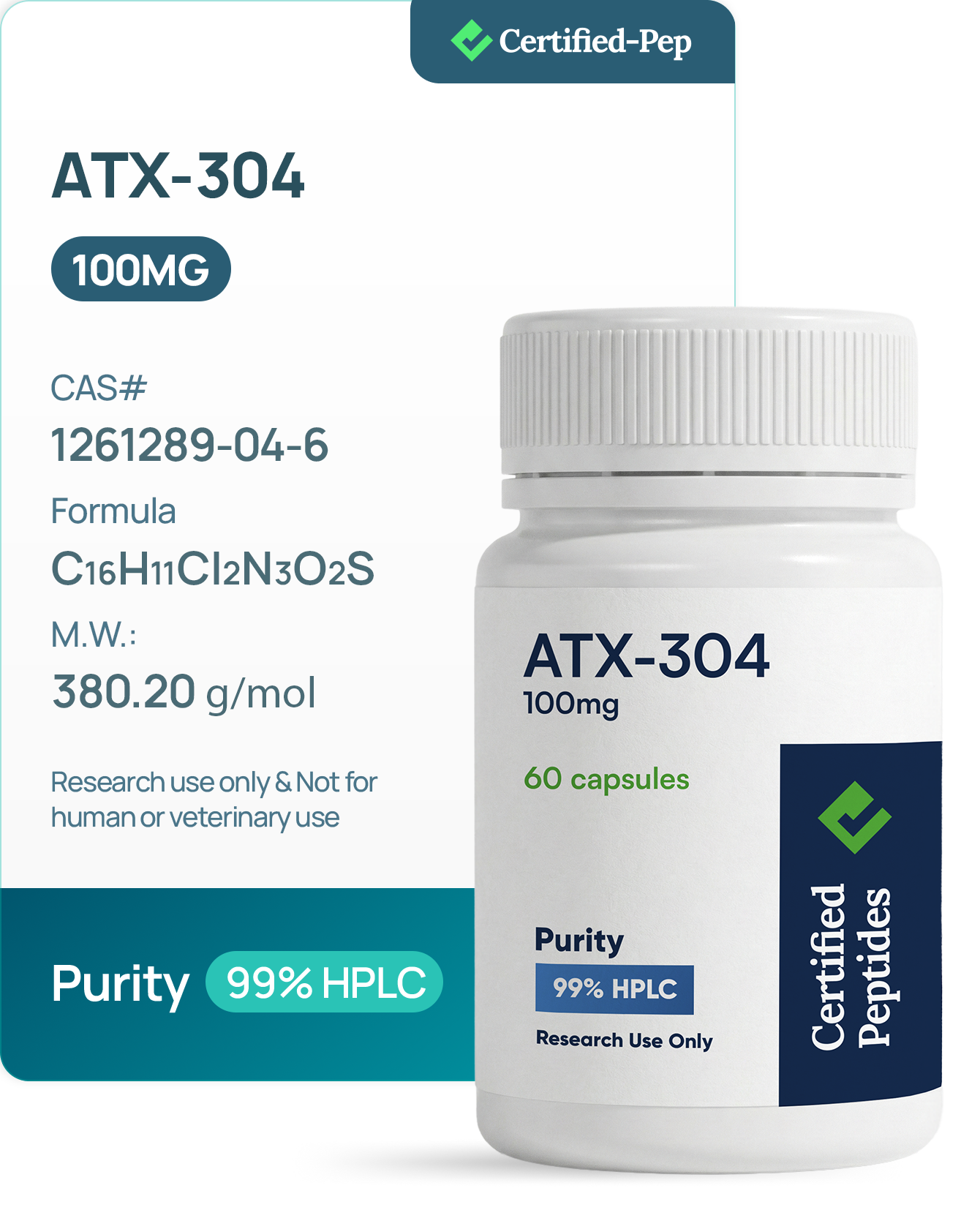
ATX-304
100mg · 60 capsules
- Ships same or next day Orders before 3PM EST, FedEx 2-Day Air
- Verify this lot View the lab report · View the Freedom Diagnostics report
- Real U.S. support Live chat and email, 7 days a week
For research use only. Not for human or veterinary consumption.
- CAS: 1261289-04-6
- FORM: Encapsulated compound
- CONTENT PER CAPSULE: 100 MG
- PURITY: 99%+
| ATX-304 100MG CAPSULES | |
|---|---|
| SKU | CP_ATX304_100MG_60CAP |
| CATEGORY | Peptide Capsules |
| CAS | 1261289-04-6 |
| VIAL SIZE | 60 Capsules per Unit |
| FORM | Encapsulated compound |
| MOLECULAR WEIGHT | 380.25 g/mol |
| SEQUENCE | N/A |
| MOLECULAR FORMULA | C16H11Cl2N3O2S |
| ITEM ID | 176741 |
An experimental small molecule investigated as a pan-AMPK activator in metabolic and cardiac mouse models.
ATX 304: the first AMPK network activator
ATX-304 is an investigational small molecule, taken by mouth in trials, that switches on AMP-activated protein kinase (AMPK). Cambrian Bio, which is developing it, calls it the first AMPK network activator to enter clinical development [1]. AMPK is the cell’s main energy sensor. Its critical metabolic sensing functions kick in when energy runs low, and from there it steers critical metabolic pathways for fatty acids, sugar and cholesterol. That gives it a hand in cellular metabolism and metabolic health in general, and its activity drops with age and metabolic disease. Each capsule holds 100 mg for laboratory research.
AMPK activation without draining cell energy
Most AMPK activators get there by decreasing cellular ATP levels, which the cell reads as stress. ATX-304 is reported to do it with ATP left intact [1]. The proposed model pairs two complementary cellular processes, more cellular glucose uptake to bring fuel in and more mitochondrial respiration to burn it, and that raises metabolic activity at the cellular and mitochondrial level. Cambrian calls this full AMPK network activation, as opposed to the partial AMPK network activation that energy stress produces.
Because respiration goes up, it gets compared to mitochondrial uncoupling. Uncoupling wastes energy as heat, though. In the reported model, mitochondrial activation keeps pace with metabolic demand, increasing energy expenditure while fuel supply keeps up, so “mitochondrial activator” is the better label.
Lipid metabolism, body fat mass and liver fat in a preclinical mouse model
Holm et al. tested it in a preclinical mouse model of progressive fatty liver disease [2]. The mice ate a choline-deficient, high-fat diet that produces metabolic dysfunction associated steatotic liver disease. On ATX-304 they lost body fat mass, and the paper reports that the compound lowers blood cholesterol levels and limits liver fat and liver fibrosis. The liver metabolic program shifted toward increased fatty acid oxidation and reduced lipid synthesis, with changes in cholesterol and lipid transport, a broad rewiring of lipid metabolism.
General liver steatosis fell, but not evenly. The liver lobes responded differently, and so did lipid distribution and where lipid droplets sat.
Glucose homeostasis and earlier AMPK data
The same compound class first appeared in a 2018 paper that reported better glucose homeostasis and insulin sensitivity in diabetic mice, plus a small trial in people with type 2 diabetes [3]. In obese mice, AMPK activation has also been linked to less ectopic fat tissue, meaning fat parked in the liver and muscle instead of in adipose tissue. These are animal findings. They point to questions worth asking, not to effects in people.
First human clinical data: metabolic effects observed
Cambrian presented the first human clinical data at the American Diabetes Association meeting in June 2026 [1]. The phase 1b trial randomized 23 adults with obesity and prediabetes to ATX-304 or placebo for 8 weeks, followed by an 8-week extension. The company reported statistically significant improvements observed across multiple metabolic parameters, including lower visceral adipose tissue and liver fat. Plasma triglycerides decreased significantly and plasma adiponectin increased significantly.
Other metabolic effects observed were an increased resting metabolic rate of about 8%, little weight loss and no change in core body temperature. Cambrian says the data demonstrate that the approach works in people. It was a small trial, and it didn’t report body composition beyond the fat measures.
Safety in the clinical trial setting
In that clinical trial setting, treatment emergent adverse events were mostly mild and about as common as on placebo [1]. Cambrian reported no adverse events indicative of mitochondrial failure, and heart rate and core body temperature stayed flat. That’s the right thing to check, since older uncoupling drugs raised body temperature dangerously. These numbers come from a company presentation, not a peer-reviewed paper. ATX-304 isn’t FDA approved, and it’s banned in competitive sport.
Body composition, muscle function and what comes next
A planned phase 2 trial will look at muscle function and assess exercise mimetic effects, which nobody has tested yet [1]. Cambrian likens the rise in energy expenditure to aerobic exercise training, but that’s still a hypothesis. Reversing metabolic decline in debilitating chronic diseases is the stated major drug development goal. The clinical evidence doesn’t yet reach claims about body weight or weight loss in people, and food intake, lean mass and long-term safety are open questions.
Quality testing and storage
Every Certified Peptides product is made in the USA. Each lot goes to an ISO/IEC 17025 accredited US lab for purity (HPLC), identity and quantity testing, and the results are on that lot’s COA. When you order ATX 304, match the QR code on the bottle to its report in the COA Library. Lab Testing explains the methods. Keep the capsules sealed, dry and out of heat and light.
For related metabolic work, see MOTS-c, which also acts through AMPK, plus SLU-PP-332 and 5-Amino-1MQ.
Questions researchers ask
How is ATX-304 different from metformin as an AMPK activator?
Metformin reaches AMPK indirectly, by blocking part of the mitochondrial chain and lowering the cell’s energy. ATX-304 reportedly skips that energy drop [1], and that difference is the main reason it’s being studied.
Why did liver lobes respond differently in the mouse study?
Holm’s group found that fat buildup and treatment effects varied by lobe and by zone within each lobe [2]. Zones get different blood flow and oxygen, which changes how liver cells handle fat, so a study that samples one lobe can miss a lot.
What readouts suit AMPK research in cells?
The usual set is phosphorylated AMPK and its target ACC, ATP and AMP levels, glucose uptake and oxygen consumption. Checking ATP next to AMPK activity is how you’d test the claim that energy levels hold. Seahorse-type assays measure mitochondrial respiration directly.
What is MASLD?
It stands for metabolic dysfunction associated steatotic liver disease, the newer name for fatty liver disease tied to obesity and diabetes. It can progress to inflammation and fibrosis, and the choline-deficient, high-fat diet is one of several mouse models for it [2].
Why does core body temperature matter for this compound?
Uncoupling agents can dump energy as heat, and some older ones caused fatal overheating. Anything that raises metabolic rate needs temperature checks, and the phase 1b trial saw no rise [1].
ATX-304 increases hepatic cholesterol uptake from blood.
Blood cholesterol was restored to 143 mg/dL in ATX-304 mice.
Total liver cholesterol increased by approximately 30% in ATX-304 mice.
AMPK activation inhibits cholesterol synthesis in the liver.
 New
 New
 New
 New