
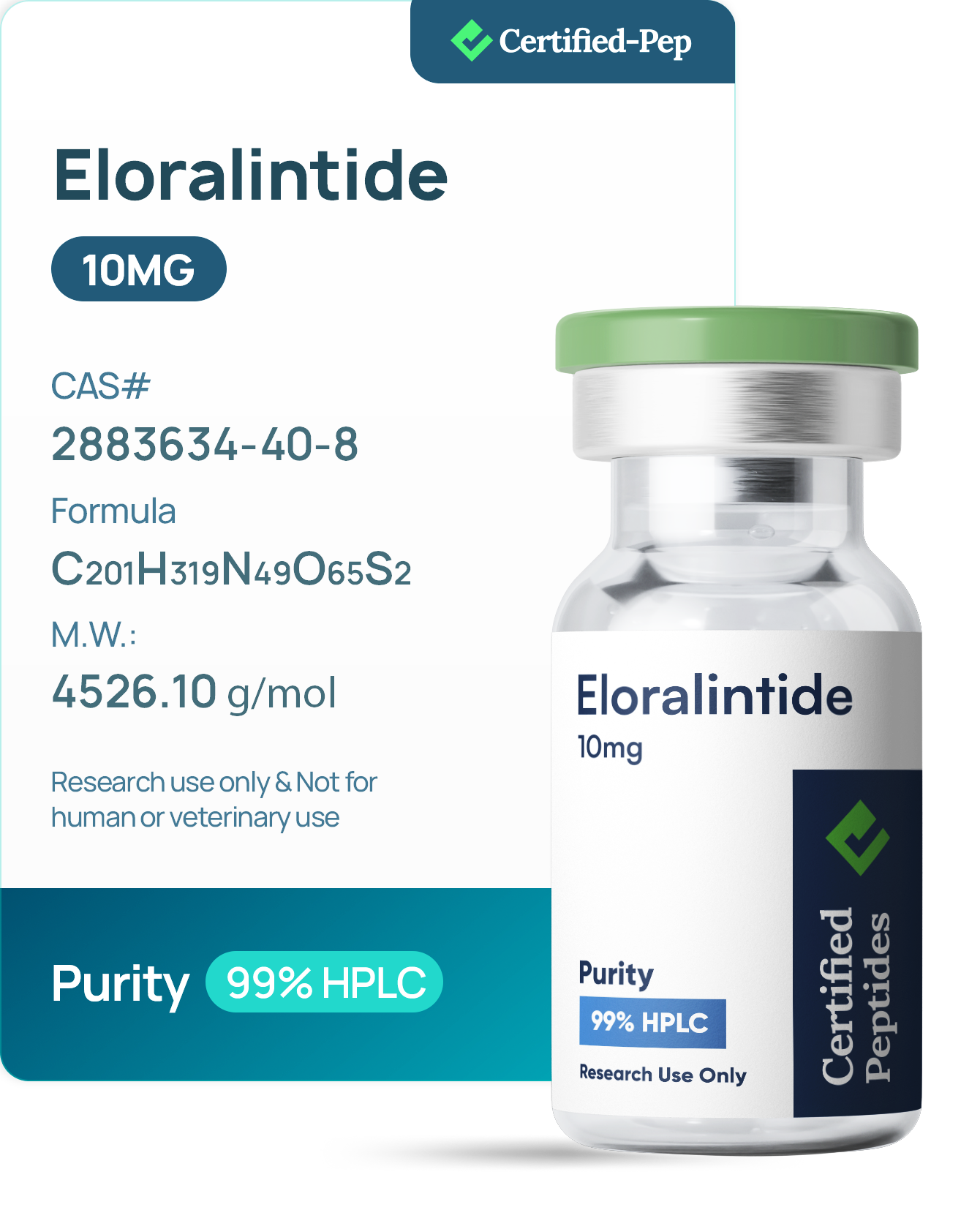
Eloralintide
10mg
- Ships same or next day Orders before 3PM EST, FedEx 2-Day Air
- Verify this lot View the lab report · View the Vanguard certificate
- Real U.S. support Live chat and email, 7 days a week
For research use only. Not for human or veterinary consumption.
| Spec | Detail |
|---|---|
| Name | Eloralintide 10MG (LY3841136) |
| Class | Selective amylin receptor agonist (long-acting amylin analog) |
| Length | 37 residues, C-terminal amide |
| Key features | Cys2 to Cys7 stabilizing bridge; Lys26 side chain with γ-glutamate linker and C20 fatty diacid |
| Molecular formula | C201H319N49O65S2 (free base) |
| Molecular weight | about 4,526 g/mol |
| CAS | 2883634-40-8. |
| Amount | 10 mg, lyophilized |
| Purity | 99%+ by HPLC (see lot COA) |
| Use | For laboratory research only |
Eloralintide: a selective amylin receptor agonist for research
Eloralintide (LY3841136) is a novel, long-acting amylin analog developed by Eli Lilly. It is a 37-residue peptide with a C-terminal amide, a stabilizing bridge between the cysteines at positions 2 and 7, and a fatty acid chain on lysine 26. That chain binds albumin in the blood, which slows clearance and stretches exposure from minutes to days. Eloralintide is an investigational drug with no FDA approval. This vial holds 10 mg of lyophilized eloralintide, made in the USA and tested to 99%+ purity, for laboratory research.
How an amylin receptor agonist works
The mechanism starts with amylin. Amylin is a hormone released from the pancreas with insulin after a meal. It signals the brain that a meal is coming to an end, promotes satiety, slows stomach emptying and lowers food intake [3]. Native amylin clears in minutes and clumps in solution, so its research potential on its own is low. Amylin receptors are built from the calcitonin receptor plus a partner protein called a RAMP. The pairings form AMY1, AMY2 and AMY3, while the calcitonin receptor alone responds mainly to calcitonin [3].
Why eloralintide is called selective
In cell assays with human receptors, eloralintide activated AMY1 at about 24 pM. It needed roughly 12-fold higher concentrations to activate the calcitonin receptor [2]. That profile is distinct from cagrilintide, which was designed to act on both amylin and calcitonin receptors. Briere et al. (2025; PubMed PMID 41109426) described the discovery work and the first clinical proof of concept [2]. In obese rats, eloralintide lowered food intake and body weight, mostly through fat mass [2]. One hypothesis is that lower calcitonin receptor activity could mean better tolerability. That idea has not been tested head to head in people.
Phase 2 study design: a 48-week, double blind, placebo controlled trial
The phase 2 study design was a randomized, double blind, placebo controlled trial (NCT06230523) [1]. It enrolled 263 adults at 46 US sites between February 2024 and August 2025. Eligibility was based on obesity, or overweight with at least one weight related comorbidity, and people with type 2 diabetes were excluded. Participants were treated in one of several arms: placebo, fixed doses of 1, 3, 6 and 9 mg, or one of two dose escalation arms. Active arms received once weekly subcutaneous eloralintide, with weight tracked through week 48. The primary endpoint was percent change in body weight at 48 weeks.
Weight loss over 48 weeks
Billings LK et al. published the results in The Lancet in 2025 [1]. Using the efficacy estimand, mean bodyweight reduction ranged from 9.5% with 1 mg to 20.1% with 9 mg, compared with 0.4% with placebo. The authors described this as dose dependent weight loss. Higher doses produced larger changes in body mass index and waist circumference. Whether weight change reaches a clear plateau with longer exposure is not established, and phase 3 studies run longer. These are reported trial results for an investigational drug, not evidence for weight management or obesity treatment with a research product.
Placebo controlled safety data and common adverse events
The most common adverse events were nausea and fatigue, and both rose with dose [1]. Nausea ranged from 11% to 64% across the active arms, compared with 14% on placebo. Nausea peaked in the fixed 6 mg arm, so the pattern was not a straight line, and the dose escalation arms reported different rates. Those common adverse events point to escalation design as a study question in its own right. Long-term safety, effects on lean mass and results in more diverse groups remain open.
Phase 3, combination studies and regulatory approval
Multiple phase 3 trials, called ENLIGHTEN, began in late 2025. They cover obesity and overweight with and without type 2 diabetes, obstructive sleep apnea and knee osteoarthritis. A separate phase 2 study tested eloralintide in combination with tirzepatide, a drug that acts on GLP-1 and GIP receptors; eloralintide itself does not engage those receptors. No company has announced a filing for regulatory approval. Eloralintide is not FDA approved, and any questions about weight, treatment or medications belong with a qualified healthcare provider. This page offers no dose or use recommendations for people; consult the published papers for study details.
Purity, COA and storage
Every lot is made in the USA, in a cGMP facility in Texas. Each batch is tested by an ISO/IEC 17025 accredited US lab for purity (HPLC), quantity, identity (LC-MS), endotoxins, heavy metals and sterility. Purity is typically 99%+, and every vial carries a QR-coded lot that links to its certificate of analysis. When you order Eloralintide 10mg, confirm your lot in the COA Library and see Lab Testing for the full panel. Lipidated peptides are sensitive to heat and repeated freeze-thaw, so keep vials sealed, cold and away from light.
Related metabolic research compounds include MOTS-c, SLU-PP-332 and 5-Amino-1MQ. Read more about Eloralintide here.
Questions researchers ask
What does the C20 fatty diacid do?
The diacid binds albumin, a carrier protein in blood, which shields the peptide from fast clearance by the kidneys. This is the same basic strategy used in other once-weekly peptides. It is the main reason eloralintide lasts days instead of minutes.
How do researchers measure amylin receptor selectivity?
Labs use cell lines that express one receptor at a time, such as the calcitonin receptor with or without a RAMP partner, and measure cAMP signaling. Comparing EC50 values across receptors gives a selectivity ratio [2]. Ratios depend on the cell line and assay, so results should be compared within one source.
How is nausea studied in rodent amylin research?
Rodents don’t vomit, so labs often use conditioned taste avoidance, where an animal learns to avoid a flavor paired with feeling unwell. Comparing taste avoidance with food intake helps separate satiety from malaise. This is the main way to test whether selectivity changes tolerability before human data exist.
Why was the efficacy estimand reported?
The efficacy estimand estimates the effect if participants stayed on the study drug. The treatment-regimen estimand counts everyone randomized, including those who stopped. Reading both gives a fuller picture of how a drug performed in a trial.
What is the source of amylin’s effect on food intake?
Amylin acts mainly on the area postrema and nearby brain stem regions that control fullness. It also slows gastric emptying, which adds to the sense of fullness after a meal. Most of its action on food intake is thought to start there [3].
Disclaimer
For laboratory research use only. Not for human or veterinary use. Not for consumption. This product is not a drug, food or cosmetic. Information on this page is for educational purposes, has not been evaluated by the FDA, and is not intended to diagnose, treat, cure or prevent any disease.
References
- Billings LK et al. “Eloralintide, a selective amylin receptor agonist for the treatment of obesity: a 48-week phase 2 trial.” Lancet. 2025;406(10520):2631-2643. The Lancet
- Briere DA et al. “Eloralintide (LY3841136), a novel amylin receptor agonist for the treatment of obesity: from discovery to clinical proof of concept.” Mol Metab. 2025;102:102271. doi:10.1016/j.molmet.2025.102271
- Hay DL, Chen S, Lutz TA, Parkes DG, Roth JD. “Amylin: Pharmacology, Physiology, and Clinical Potential.” Pharmacol Rev. 2015;67(3):564-600. PubMed
- ClinicalTrials.gov. Phase 2 study of LY3841136 in adults with obesity or overweight. NCT06230523. ClinicalTrials.gov
 New
 New
 New
 New