
What Is Eloralintide? A Selective Amylin Receptor Agonist Explained
Eloralintide is an investigational, long-acting amylin analogue built to act as a selective amylin receptor agonist, given as a once-weekly injection in clinical studies. Eli Lilly is developing it for the treatment of obesity, and it is not FDA approved.
It is also one of the most closely watched compounds in metabolic research right now. Its 48-week phase 2 results, published in The Lancet in December 2025, showed body weight falling by as much as 20.1% [1]. By 2026, five phase 3 studies were enrolling. And researchers see amylin drugs as the next major class after GLP-1.
Our Eloralintide Peptide is now in the Certified-PEP lineup for research use. Here is what it is, how it works, what the trials found and what is still unknown.
What Is Eloralintide?
Eloralintide is a lab-made version of amylin, a hormone released from the pancreas alongside insulin after a meal. Amylin tells the brain that a meal is over. It promotes satiation, slows gastric emptying and lowers food intake, so it works as a natural brake on calorie intake [3].
Native amylin is a poor research tool on its own. It clears from the body within minutes and tends to clump in solution. That is why chemists have spent decades building amylin analogues that last longer and stay stable.
| Property | Eloralintide |
|---|---|
| Code name | LY3841136 |
| Class | Long-acting amylin analogue; selective amylin receptor agonist |
| Developer | Eli Lilly |
| Chain | 37-residue peptide with a stabilized ring between positions 2 and 7 |
| Half-life extension | C20 fatty diacid on a lysine, attached through glutamic acid linkers |
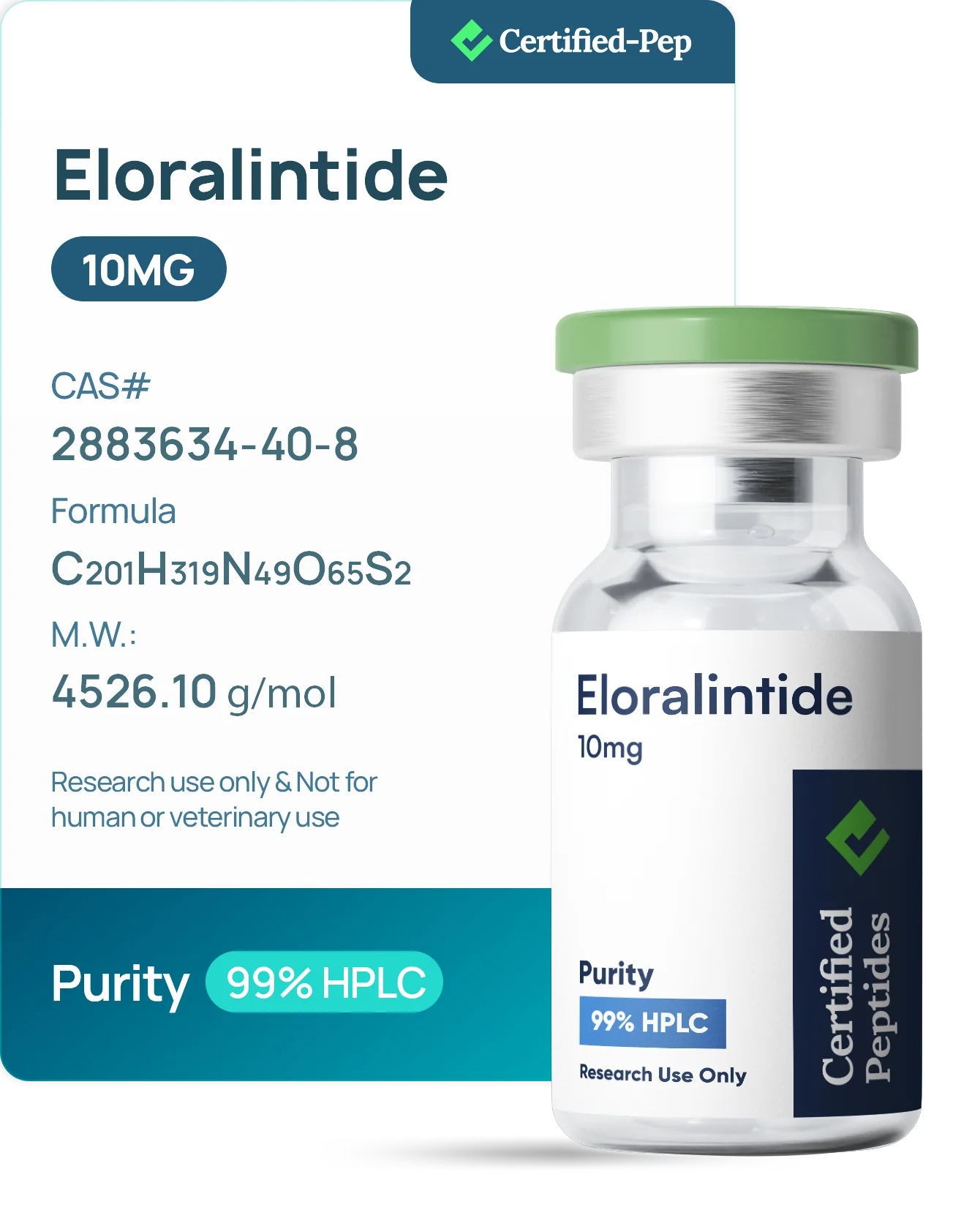
| Approx. molecular weight | 4,526 g/mol |
| Schedule tested in trials | Weekly injection |
| Status | Investigational drug in phase 3; no FDA approval |
The fatty acid chain is the key to weekly dosing. It lets the peptide bind albumin in the blood, which slows clearance and stretches exposure kinetics from minutes to days [2].
The first amylin drug, pramlintide, was FDA approved in 2005 for diabetes. It needs frequent dosing before meals. Eloralintide belongs to a newer wave of long-acting amylin drugs, alongside cagrilintide from Novo Nordisk and petrelintide from Zealand Pharma and Roche, that aim for weekly dosing and weight management.
How Does Eloralintide Work as a Selective Amylin Receptor Agonist?
The amylin receptor and the calcitonin receptor
Amylin receptors are built from parts. Each one starts with a calcitonin receptor and adds a partner protein called a RAMP (receptor activity-modifying protein). The partner changes what the receptor responds to. Calcitonin receptor plus RAMP1 forms AMY1, plus RAMP2 forms AMY2, and plus RAMP3 forms AMY3 [3]. The calcitonin receptor on its own responds most strongly to calcitonin, a hormone tied to calcium and bone.
So an amylin receptor agonist can hit several related targets at once. Which ones it favors is a question of receptor pharmacology, and it is the core idea behind eloralintide.
Receptor selectivity
In cell assays using human receptors, eloralintide strongly preferred AMY1 [2].
| Human receptor | EC50 (cAMP assay) | Relative to AMY1 |
|---|---|---|
| AMY1 | 23.9 pM | Reference |
| AMY3 | 253.8 pM | About 11-fold weaker |
| Calcitonin receptor | 291 pM | About 12-fold weaker |
That is a targeting ratio, not “12 times better.” It means eloralintide activates AMY1 at much lower concentrations than it needs for the calcitonin receptor. Cagrilintide, by contrast, was designed to activate both amylin and calcitonin receptors [8].
What it does in the body
Eloralintide acts on amylin receptors in the brain stem and other parts of the central nervous system that control fullness, affecting satiety at its source. The result is physiological satiation: decreased appetite and reduced food intake. It also slows stomach emptying, so a meal stays in the stomach longer.
In diet-induced obese rats, eloralintide reduced food intake and body weight dropped by up to 12.3%, mostly from fat mass [2]. Whether it also raises energy expenditure is still an open question.
Here is the hypothesis that has researchers excited. Calcitonin receptor activity may drive part of the nausea seen with amylin drugs. If so, a more selective compound could cause fewer gastrointestinal events at the same level of weight loss. Labs test nausea-like responses in rodents with conditioned taste avoidance, where an animal learns to avoid a flavor paired with feeling unwell. In people, the idea has not been proven, and no head-to-head trial has tested it.
Eloralintide vs. GLP-1 Drugs and Cagrilintide
GLP-1 receptor agonists such as semaglutide act on a different pathway than an amylin receptor agonist. GLP-1 drugs mimic a gut hormone. Amylin drugs mimic a pancreatic hormone that works on its own set of brain circuits. That difference is why amylin based pharmacotherapy is called the next major class in obesity research, and why it is so often studied next to GLP-1 drugs rather than in place of them.
| Eloralintide | Cagrilintide | GLP-1 drugs (e.g., semaglutide) | |
|---|---|---|---|
| Hormone mimicked | Amylin | Amylin | GLP-1 |
| Main targets | AMY1, with lower calcitonin receptor activity | Amylin and calcitonin receptors | GLP-1 receptor |
| Developer | Eli Lilly | Novo Nordisk | Several |
| Status | Phase 3 | Late-stage trials, alone and with semaglutide | Approved products exist |
Combination work is where the momentum is building. Tirzepatide already activates GLP-1 and GIP receptors. In a 48-week phase 2 trial of 367 adults with type 2 diabetes and obesity or overweight, presented at the EASD congress in October 2026, eloralintide plus tirzepatide reached up to 23.3% weight loss, compared with 14.8% for tirzepatide 15 mg alone. HbA1c fell by 2.9% with the combination and 2.4% with tirzepatide [6]. Pivotal trials of the combination are expected to start before the end of 2026.
The short version: eloralintide runs on a different operating system. That makes it interesting as a partner for GLP-1 drugs. It does not make it proven better, and the trials so far have not compared it head to head with GLP-1 drugs or cagrilintide.
Eloralintide Clinical Trial Results: The 48-Week Phase 2 Study
Study design
The phase 2 clinical trial (NCT06230523) was double blind, randomised and placebo-controlled [1][4]. It enrolled 263 adults at 46 US centers between February 2024 and August 2025.
- Who took part: ages 18 to 75, with a body mass index of 30 or higher, or 27 or higher with a weight-related condition. People with type 2 diabetes were excluded.
- Arms tested: placebo, fixed 1, 3, 6 and 9 mg, and two dose escalation arms (6 to 9 mg and 3 to 9 mg), all as a weekly injection.
- Primary endpoint: percent change in body weight at 48 weeks.
Participants averaged 49 years old, 109.1 kg and a BMI of 39.1. About 78% were female, which limits how far the results generalize.
Weight loss results
Weight loss rose with dose. The figures below use the efficacy estimand, which estimates the effect if participants stayed on the study drug [1].
| Arm | Participants | Mean weight change at 48 weeks |
|---|---|---|
| Placebo | 53 | -0.4% |
| 1 mg | 28 | -9.5% |
| 3 mg | 24 | -12.4% |
| 6 mg | 28 | -17.6% |
| 9 mg | 54 | -20.1% |
| 6 to 9 mg escalation | 24 | -19.9% |
| 3 to 9 mg escalation | 52 | -16.4% |
Weight loss ranged from 9.5% to 20.1% across doses, against 0.4% with placebo. The Lancet authors called it clinically meaningful, dose-dependent weight loss over 48 weeks [1].
Other measures
Secondary measures included body mass index and waist circumference. Coverage of the trial has also mentioned metabolic markers such as LDL cholesterol and triglycerides, but those figures are not in the published abstract, so we leave them out here.
Because people with diabetes were excluded, this trial did not test whether eloralintide can lower blood sugar. Blood glucose effects are being studied in other trials.
Eloralintide Side Effects and Safety
The most common adverse events were gastrointestinal events, mainly nausea, and fatigue. Both tended to rise at higher doses [1].
| Arm | Nausea | Fatigue |
|---|---|---|
| Placebo | 14% | 12% |
| 1 mg | 11% | 0% |
| 3 mg | 13% | 13% |
| 6 mg | 64% | 29% |
| 9 mg | 33% | 43% |
| 6 to 9 mg escalation | 54% | 46% |
| 3 to 9 mg escalation | 25% | 21% |
Nausea peaked in the fixed 6 mg arm, not the 9 mg arm, so the pattern is not a straight line. That points to dose escalation design as a lever worth studying. In the combination trial, discontinuation from side effects reached 27% in the highest-performing group, compared with 2.9% on tirzepatide and 16.7% on placebo [6]. The groups were small, so those rates are rough.
Selectivity may mean better tolerability than other amylin drugs, but that remains a hypothesis. Longer-term questions are still open, including lean mass loss, long term safety, and how results hold up in larger, more diverse groups. Phase 3 is built to answer them.
Is Eloralintide FDA Approved? Phase 3 and What Comes Next
No. Eloralintide is an investigational drug with no FDA approval, and no submission has been announced. What has changed is the scale of the program. By 2026, five phase 3 studies, together called ENLIGHTEN, were listed as enrolling, with a combined goal of about 5,600 participants [5][7].
| Study | Registry ID | Population |
|---|---|---|
| ENLIGHTEN-1 | NCT07321886 | Obesity or overweight, no diabetes |
| ENLIGHTEN-2 | NCT07282600 | Obesity or overweight with type 2 diabetes |
| ENLIGHTEN-3 | NCT07369011 | Obstructive sleep apnoea with obesity or overweight |
| ENLIGHTEN-4 | NCT07353931 | Knee osteoarthritis with obesity or overweight |
| ENLIGHTEN-6 | NCT07392190 | Excess weight that persists on stable weekly incretin therapy |
ENLIGHTEN-1 alone plans to enroll 1,980 adults, with a main phase of about 75 weeks against placebo [5]. Add the eloralintide and tirzepatide combination program, plus cagrilintide and petrelintide moving through their own trials, and amylin is shaping up as a full drug class, and a new chapter in weight loss therapy research, rather than a single compound.
Where Researchers Get Eloralintide
Eloralintide is now in stock at Certified-PEP. Labs studying amylin receptors, receptor selectivity, gastric emptying and satiety signaling can source Eloralintide 10mg from a supplier that documents every lot before it ships.
- Format: 10mg research vial.
- Lot testing: each lot is tested by an ISO/IEC 17025 accredited lab. Check the current certificate of analysis in our COA library, and see our lab testing page for what each test covers.
- Research use: sold strictly for laboratory research and not for human consumption.
Working on energy metabolism more broadly? Related compounds in our catalog include MOTS-c, SLU-PP-332, 5-Amino-1MQ and NAD+.
Eloralintide for Research Use
Frequently Asked Questions
Is eloralintide a GLP-1?
No. Eloralintide is an amylin receptor agonist. It mimics amylin, a pancreatic hormone, while GLP-1 drugs mimic a gut hormone and act on a different receptor.
Does eloralintide lower blood sugar?
The phase 2 trial excluded people with type 2 diabetes, so it did not answer that. A combination trial with tirzepatide in type 2 diabetes reported HbA1c reductions, and ENLIGHTEN-2 is studying eloralintide in type 2 diabetes.
How is eloralintide different from cagrilintide?
Both are long-acting amylin analogues. Cagrilintide activates amylin and calcitonin receptors, while eloralintide favors the AMY1 amylin receptor. No trial has compared them directly.
How long was the phase 2 study?
The main phase ran 48 weeks, with weight change at week 48 as the primary endpoint. The ENLIGHTEN-1 phase 3 study runs longer, with a main phase of about 75 weeks.
References
- Billings LK et al. “Eloralintide, a selective amylin receptor agonist for the treatment of obesity: a 48-week phase 2 trial.” Lancet. 2025;406(10520):2631-2643. The Lancet
- Briere DA et al. “Eloralintide (LY3841136), a novel amylin receptor agonist: from discovery to clinical proof of concept.” Mol Metab. 2025;102:102271. DOI
- Hay DL, Chen S, Lutz TA, Parkes DG, Roth JD. “Amylin: Pharmacology, Physiology, and Clinical Potential.” Pharmacol Rev. 2015;67(3):564-600. PubMed
- ClinicalTrials.gov. Eloralintide phase 2 study record. NCT06230523. ClinicalTrials.gov
- ClinicalTrials.gov. “A Study of Eloralintide (LY3841136) in Participants With Obesity, or Overweight Without Type 2 Diabetes” (ENLIGHTEN-1). NCT07321886. ClinicalTrials.gov
- “New Lilly combo tops tirzepatide for weight loss in diabetes.” Pharmaphorum. October 1, 2026. Pharmaphorum
- “Eloralintide: Trials, Results & FDA Status.” The Rx Index. August 2026. The Rx Index
- Lau DCW et al. “Once-weekly cagrilintide for weight management in people with overweight and obesity: a multicentre, randomised, double-blind, placebo-controlled and active-controlled, dose-finding phase 2 trial.” Lancet. 2021;398(10317):2160-2172. PubMed
Research use only
Certified-PEP products are sold strictly for laboratory research. They are not drugs, foods, cosmetics or dietary supplements, and they are not for human or veterinary use. This article reports published clinical trial results as background on an investigational drug; it does not offer guidance for use in people. Read our research purposes only policy before you order.