

Semax
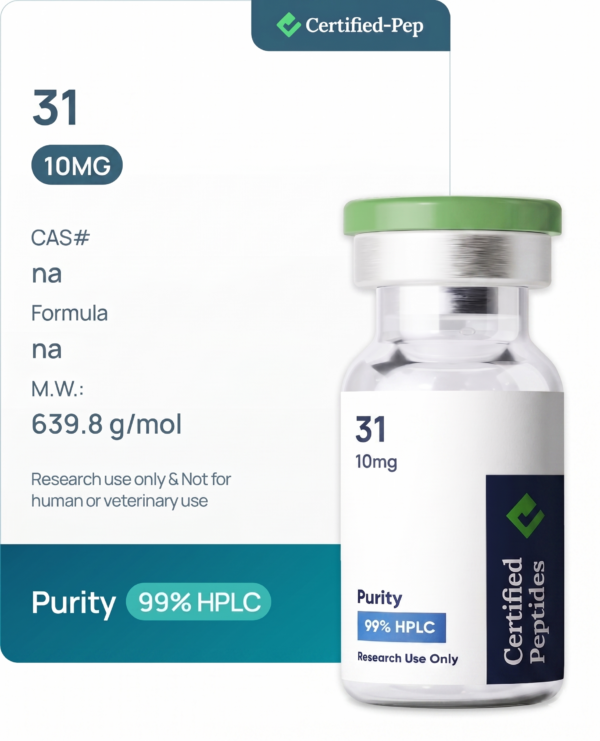
10mg
- Ships same or next day Orders before 3PM EST, FedEx 2-Day Air
- Verify this lot View the lab reports · View the Vanguard certificate
- Real U.S. support Live chat and email, 7 days a week
For research use only. Not for human or veterinary consumption.
- PURITY: 99%+
- CAS: 80714-61-0
- FORM: LYOPHILIZED POWDER
- DOSAGE: 10 MG
- PURITY: 99%+
| SEMAX 10MG | |
|---|---|
| SKU | CP_SEMAX_10MG_3ML_VIAL |
| CATEGORY | Research Compound |
| CAS | 80714-61-0 |
| VIAL SIZE | 3 mL |
| FORM | LYOPHILIZED POWDER |
| MOLECULAR WEIGHT | 813.92 g/mol |
| SEQUENCE | Met-Glu-His-Phe-Pro-Gly-Pro |
| MOLECULAR FORMULA | C37H51N9O10S |
| N-TERMINUS | Free amine group |
| C-TERMINUS | Free proline carboxylic acid group |
| ITEM ID | 847 |
SEMAX 10MG provides Semax as lyophilized powder in a 3 mL vial.
Semax peptide: a synthetic peptide derived from ACTH(4-10)
Semax is a seven-residue synthetic peptide derived from adrenocorticotropic hormone (ACTH). Its sequence, Met-Glu-His-Phe-Pro-Gly-Pro, joins ACTH(4-7) to a Pro-Gly-Pro tail. The compound was developed at the Institute of Molecular Genetics of the Russian Academy of Sciences as a stable analogue of the ACTH(4-10) fragment, which had shown effects on learning and memory in rats [1]. This vial holds 10 mg of lyophilized Semax peptide, 813.92 g/mol, with a free amine at the N-terminus and a free carboxylic acid at the C-terminus.
Why the sequence is built this way
The first four amino acids, Met-Glu-His-Phe, carry the activity researchers associate with the ACTH(4-10) fragment. Short ACTH fragments break down within minutes, so the Phe-Pro-Gly-Pro end was added to slow degradation by peptidases. The result keeps the central nervous system activity studied in the ACTH fragments while lacking the hormone's effect on the adrenal glands, so Semax doesn't act as a corticotropic hormone.
Semax and brain derived neurotrophic factor
The best-characterized finding involves brain derived neurotrophic factor (BDNF), a protein essential for the growth, survival and plasticity of neurons. Dolotov et al. (2006) gave rats a single dose of Semax and measured BDNF and its receptor, TrkB, in the rat hippocampus [1]. Within hours, BDNF protein and TrkB activation rose, and the authors linked those changes to Semax's effects on learning. That study is the main evidence behind the compound's research focus on neurotrophic signaling and cognition.
Neuroprotection in rat ischemic stroke models
Semax has also been evaluated in rat models of ischemic stroke. Dmitrieva et al. (2010) found that after cerebral ischemia, Semax and its Pro-Gly-Pro tail activated transcription of neurotrophin genes and their receptors [2]. A genome-wide analysis by Medvedeva et al. (2014) showed that Semax shifted expression of genes tied to the immune and vascular systems in the ischemic rat brain [3]. Those changes, indicating shifts in immune and vascular gene programs, support research on neuroprotection and are the basis for describing neuroprotective effects in animals. They say nothing yet about stroke recovery in people.
Dopamine, serotonin and behavior in rodents
Eremin et al. (2005) found that Semax activated dopamine and serotonin systems in the rodent brain, with the clearest effects in the striatum [4]. That pattern is one reason Semax appears in rodent research on attention, stress-related behavior and mood-related readouts. How those neurotransmitter effects connect to the BDNF findings is still under study.
Nasal spray delivery in Semax research
Short peptides cross the blood brain barrier poorly. Most animal studies therefore administered Semax intranasally, a route that can reach the brain along olfactory pathways [1], and the product registered in Russia is a nasal spray solution. For laboratory work, the vial here is a lyophilized powder; delivery format, buffer and concentration should be chosen for the suitability of your own protocol.
Regulatory status and history
Semax has a long history in Russia, where it is registered as a medicine and has been studied in patients after ischemic stroke and with cognitive disorders. That work is mostly small and published in Russian, so its clinical significance outside the few countries where it is registered is uncertain. In the United States, Semax is not FDA approved for any use, and it is sold here only as a research compound. Online peptide products vary widely in quality, which makes identity and purity evaluation the first step for any lab.
What is still unknown
Most mechanism data come from rats and in vitro work, and the potential effects seen in animals haven't been confirmed in controlled trials outside Russia. Long-term safety hasn't been characterized, and there are no data on pregnancy. This page makes no claims about symptoms, treatment or benefits in people.
Quality testing and storage
Certified Peptides manufactures in a cGMP facility in Texas. Every batch is tested by an ISO/IEC 17025 accredited US lab for purity (HPLC), quantity, identity (LC-MS), endotoxins, heavy metals and sterility, so you receive HPLC-purified material with a lot-matched analysis. When you order this Semax peptide, match the QR-coded lot on the vial to its report in the COA Library. Keep vials sealed, cold and away from light for storage, and see Lab Testing for the full panel.
Related research compounds in the same category include Selank 10 MG, another peptide from the same institute, the Selank / Semax 10/10MG blend and Cerebrolysin.
Questions researchers ask
How is Semax related to ACTH(4-10)?
Semax keeps the first four residues of the ACTH(4-10) fragment, Met-Glu-His-Phe, and replaces the rest with a Pro-Gly-Pro tail. The tail slows breakdown by peptidases, which is the main reason Semax lasts longer in experiments than the native fragment. It also drops the corticotropic activity of full-length ACTH.
What does the Pro-Gly-Pro tail do on its own?
Pro-Gly-Pro is itself biologically active in some models. In rat ischemia studies, the tripeptide alone also changed transcription of neurotrophin genes, though the pattern differed from full Semax [2]. Labs studying Semax often run Pro-Gly-Pro as a separate arm to separate the effects of the two parts.
Why did most animal studies give Semax intranasally?
Peptides of this size cross the blood brain barrier poorly when given into the bloodstream. Intranasal delivery can carry them toward the brain along olfactory and trigeminal pathways, which is why that route dominates the rat literature [1]. Results from intranasal studies may not match other routes.
Which brain regions have been measured in Semax studies?
The hippocampus is the main region for BDNF and TrkB measurements [1]. Ischemia studies measured the cortex around the damaged area [2], [3], and neurotransmitter work focused on the striatum [4]. Matching your tissue to the published region makes results easier to compare.
How is Semax broken down?
Peptidases cut Semax into shorter fragments, and some of those fragments, including Pro-Gly-Pro, are active on their own. Identifying those fragments by LC-MS is the basis of both stability studies and drug testing methods. For lab work, the lot COA confirms the intact 813.92 g/mol mass before you start.
How should lyophilized Semax be stored?
Keep the vial sealed, dry and protected from light, and follow the storage notes on the lot COA. Many labs hold lyophilized peptides at −20 °C for long-term storage. Semax contains a methionine that can oxidize, so limit air exposure once a vial is open.
Disclaimer
For laboratory research use only. Not for human or veterinary use. Not for consumption. This product is not a drug, food or cosmetic. Information on this page is for educational purposes, has not been evaluated by the FDA, and is not intended to diagnose, treat, cure or prevent any disease.
References
- Dolotov OV et al. "Semax, an analog of ACTH(4-10) with cognitive effects, regulates BDNF and trkB expression in the rat hippocampus." Brain Res. 2006;1117(1):54-60. PubMed 16996037
- Dmitrieva VG et al. "Semax and Pro-Gly-Pro activate the transcription of neurotrophins and their receptor genes after cerebral ischemia." Cell Mol Neurobiol. 2010;30(1):71-79. PubMed
- Medvedeva EV et al. "The peptide semax affects the expression of genes related to the immune and vascular systems in rat brain focal ischemia: genome-wide transcriptional analysis." BMC Genomics. 2014;15:228. doi:10.1186/1471-2164-15-228
- Eremin KO et al. "Semax, an ACTH(4-10) analogue with nootropic properties, activates dopaminergic and serotoninergic brain systems in rodents." Neurochem Res. 2005;30(12):1493-1500. PubMed
 Sale
