
Eloralintide Research Guide
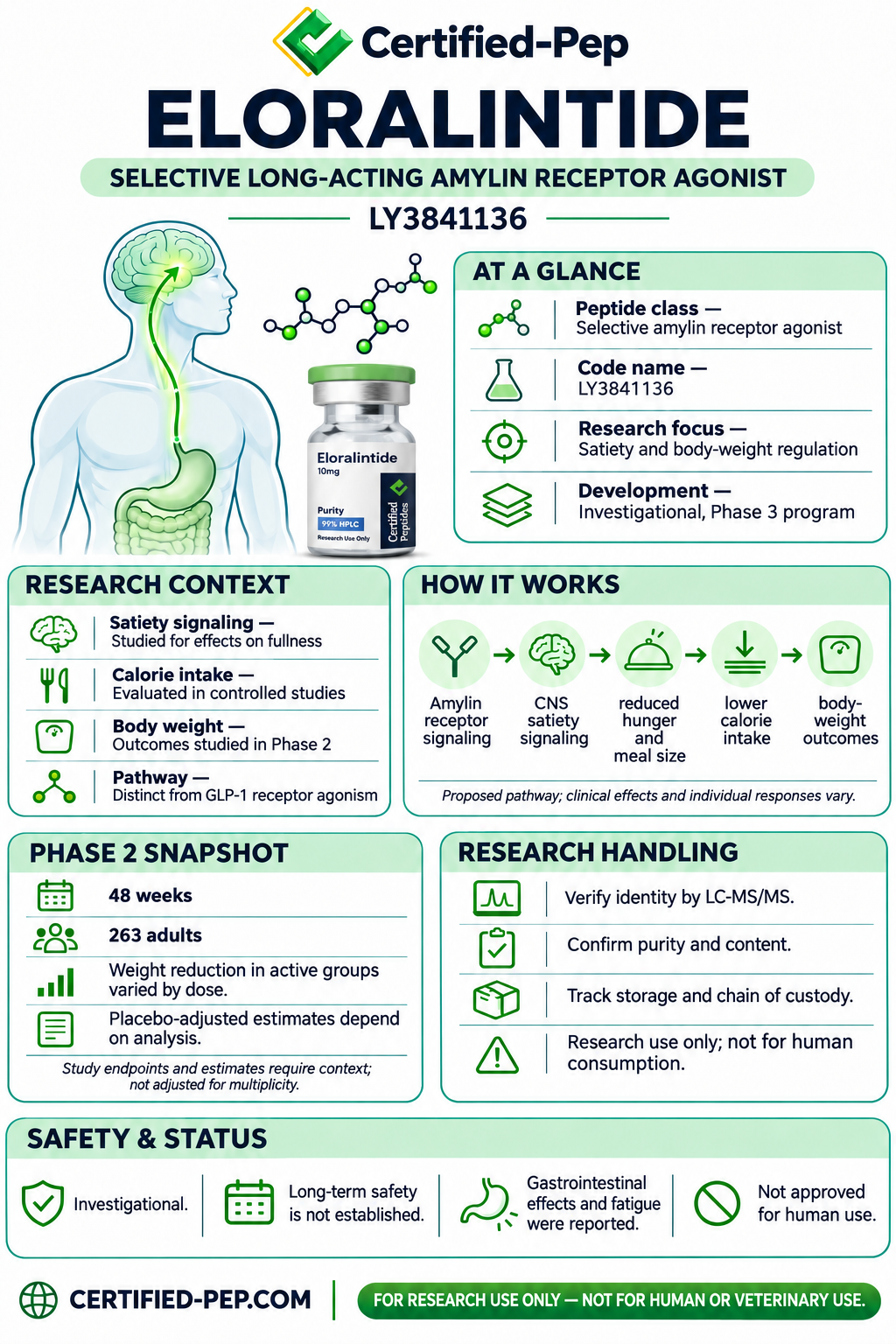
Eloralintide (LY3841136) is an investigational, long-acting amylin receptor agonist being studied for weight management. The infographic below summarizes its proposed pathway, early clinical research, and key considerations for researchers. Eloralintide is not approved for human use; the information here is educational and for research context only.
Explore our eloralintide resources for product information, research comparisons, and answers to common questions. Any material offered for research is not intended for human or veterinary use.
Eloralintide resources
- Shop Eloralintide online
- Eloralintide vs. Cagrilintide
- Eloralintide vs. GLP-3R
- What Is Eloralintide?
Eloralintide FAQ
- Is eloralintide a GLP-1?
- What are the benefits of taking eloralintide?
- How long does eloralintide take to work?
- What are the side effects of eloralintide?
- Does eloralintide make you tired?
- What are the reviews like for eloralintide?
- What is the difference between cagrilintide and eloralintide?
- Can cagrilintide be used alone to lose weight?
- Do you cycle off cagrilintide?
- When is the best time to inject cagrilintide?
- Is GLP3 the same as retatrutide?
- What peptide is comparable to retatrutide?
- What works better than tirzepatide?
- What is the poor man’s alternative to Ozempic?
What researchers should know about eloralintide
Eloralintide, also known by the development code LY3841136, is a peptide designed to activate amylin receptors. Amylin is a hormone released by pancreatic beta cells alongside insulin after eating. It contributes to meal-related satiety and can slow gastric emptying. The amylin receptor is formed when the calcitonin receptor pairs with a receptor activity-modifying protein (RAMP); different RAMPs create the AMY1, AMY2, and AMY3 receptor subtypes. This receptor family is distinct from the GLP-1 receptor.
That distinction is the main way to understand eloralintide’s place among appetite-related compounds. GLP-1 receptor agonists act on GLP-1 receptors, while eloralintide is being developed to act on amylin receptors. Both systems may influence appetite and food intake, but shared effects do not make them the same mechanism or drug class. Research is also exploring combinations across pathways, but combination results must be interpreted within the specific study design and cannot establish general outcomes for other people or settings.
Eloralintide is described in the published Phase 1 research as a selective, long-acting amylin receptor agonist with a pharmacokinetic profile supporting once-weekly investigational dosing. Its developers report greater potency at amylin receptors than at calcitonin receptors. Selectivity observed in pharmacology studies is useful for characterizing a molecule; by itself, it does not prove which receptor subtype drives clinical effects or predicts how an individual will respond. The Phase 1 publication discusses receptor biology, pharmacokinetics, and early safety observations.
Clinical findings are preliminary. In a 48-week Phase 2 randomized, placebo-controlled trial, 263 adults with obesity or overweight plus a weight-related complication, without type 2 diabetes, were assigned to once-weekly eloralintide dose groups or placebo. The study reported average body-weight reductions that varied by dose, from roughly 9% in the 1 mg group to roughly 20% in the 9 mg and 6-to-9 mg groups; the placebo group changed by about 0.4% in the opposite direction. These are group averages from one trial, not a forecast for an individual. They should not be directly compared with results from separate trials of other compounds because populations, methods, endpoints, and follow-up may differ. The published Phase 2 report provides the trial methods and estimates.
Reported adverse events included nausea and fatigue, and their frequency varied among dose groups. A 48-week study cannot establish long-term safety, and the investigational findings do not establish an approved use. Further trials are needed to clarify the benefit-risk profile, optimal dosing approach, and how receptor selectivity relates to outcomes. Researchers should review full publications and registered study records, including participant characteristics, statistical methods, confidence intervals, discontinuations, and adverse events, before drawing conclusions.
Research use only. Eloralintide is investigational and is not approved for human use. This article is educational and is not medical advice.