
 Sale
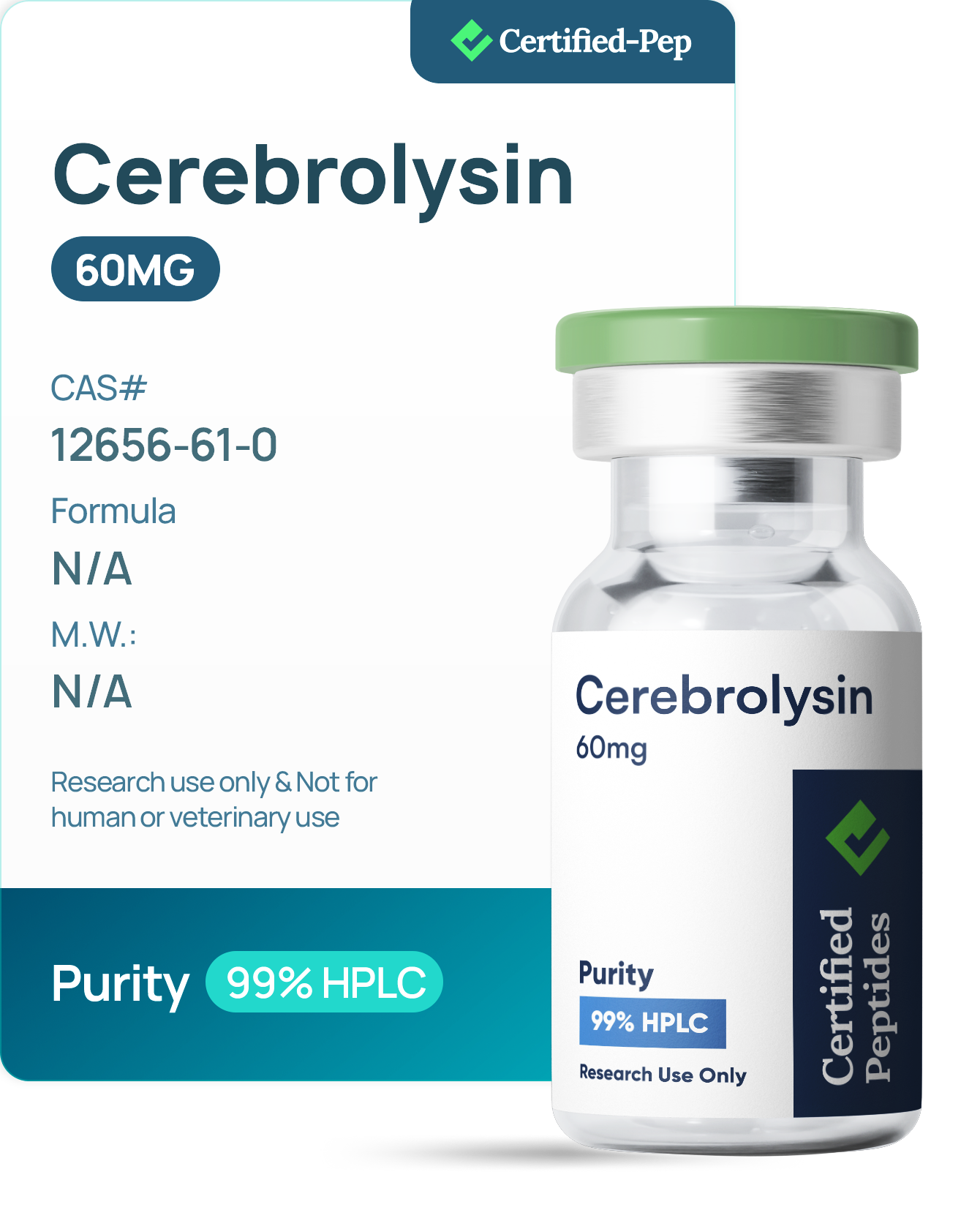
Cerebrolysin
60mg 10ml vial
- Ships same or next day Orders before 3PM EST, FedEx 2-Day Air
- Verify this lot View the lab reports · View the Vanguard certificate
- Real U.S. support Live chat and email, 7 days a week
For research use only. Not for human or veterinary consumption.
- PURITY: 99%+
- CAS: 12656-61-0
- FORM: LYOPHILIZED POWDER
- DOSAGE: 60 MG
- PURITY: 99%+
| CEREBROLYSIN 60MG 10ML VIAL | |
|---|---|
| SKU | CP_CEREBROSLYN_60MG_10ML_VIAL |
| CATEGORY | Lyophilized Research Blend |
| CAS | 12656-61-0 |
| VIAL SIZE | 10 mL |
| FORM | LYOPHILIZED POWDER |
| MOLECULAR WEIGHT | Not applicable to proprietary mixture |
| COMPOSITION | Complex low-molecular-weight peptide and amino-acid mixture |
| MOLECULAR FORMULA | Not applicable to proprietary mixture |
| ITEM ID | 100060 |
CEREBROLYSIN 60MG 10ML VIAL is supplied as a lyophilized powder in a 10 mL vial. It is a multi-component product identified as Cerebrolysin-designated peptide mixture. Because a blend is not a single molecule, one CAS number, molecular weight, molecular formula, or peptide sequence does not apply to the finished mixture.
Cerebrolysin: a multimodal neuropeptide preparation
Cerebrolysin isn't a single molecule. It's a complex mixture made by breaking down purified pig brain with enzymes, which leaves low molecular weight peptide fragments, mostly under 10 kDa, alongside free amino acids. Ever Pharma in Austria has made it since the 1950s, and it's often described as a multimodal neuropeptide preparation because no one component explains what it does. Because the fragments are small, part of the mixture is thought to cross the blood brain barrier. This vial holds 60 mg for laboratory research.
How cerebrolysin works on brain cells in preclinical research
Most of the mechanism comes from preclinical research in cell culture and rodents. The mixture behaves like the neurotrophic factors the brain makes itself, which is why papers compare it to brain derived neurotrophic factor and nerve growth factor. Reported effects on brain cells include more BDNF synthesis, better neuronal survival, less glutamate excitotoxicity and less uncontrolled apoptosis. Animal work also describes axonal sprouting, new neural connections and higher synaptic density in the hippocampus, a brain region tied to memory formation, plus changes in synaptic regulation and neural transmission.
One line of work points at the sonic hedgehog signaling pathway. In rodent stroke models, cerebrolysin improved neurological function alongside raised shh pathway activity, and blocking the pathway cut the effect [2]. Other studies describe lower pro inflammatory cytokines and effects on the neurovascular unit and on toxic protein aggregates. These are animal findings. They set up questions rather than settle them.
Acute ischemic stroke: the effect of cerebrolysin on functional outcomes
The effect of cerebrolysin in acute ischemic stroke is where the clinical data are thickest and least flattering. Trials in ischemic stroke patients, mostly in eastern european countries and asian countries, reported positive effects on motor function and motor recovery in some rehabilitation settings, and the CARS trial reported improved functional recovery [4]. A 2023 Cochrane review pulled together seven randomised trials with 1,773 participants in acute ischaemic stroke [1]. Across those clinical trials it found cerebrolysin probably makes little to no difference to death, with no clear benefit for preventing death, and it couldn't assess functional outcomes because no included study reported poor functional outcome. Three of the trials were supported by the manufacturer.
Alzheimer's disease, vascular dementia and cognitive impairment in dementia patients
In dementia patients, a trial in mild-to-moderate Alzheimer's disease published in the European Journal of Neurology reported better scores on cognitive and global scales [3], and some work in mild cognitive impairment reported improved cognitive performance against a control group. Evidence in vascular dementia is low-certainty. Across both, studies have been small, short and uneven in design, and systematic reviews keep landing on the same verdict: possible benefit, weak clinical data. Cerebrolysin is approved in more than 45 countries for dementia, but it is not FDA-approved in the United States.
Cerebrolysin administered after traumatic brain injury
Cerebrolysin administered after traumatic brain injury has been studied for cognitive symptoms and recovery, and a meta analysis of TBI trials reported modest benefit in some outcomes. Smaller studies looked at the negative symptoms of schizophrenia, a literature that one review found schizophrenia dominated by very small trials, and at retinal conditions. None of this reaches the standard that would change practice in the United States.
Cognitive enhancement, cognitive functions and brain fog
Online, cerebrolysin is marketed to healthy adults for cognitive enhancement, mental clarity and brain fog. The clinical studies were done in people with a diagnosed injury or disease, not in healthy adults, so the cognitive benefits reported there say nothing about cognitive functions in someone without one. No trial has tested it for brain fog. That gap between the preclinical studies and the marketing is the single biggest thing to notice about this compound.
How does cerebrolysin compare with a single peptide?
How does cerebrolysin compare with a defined peptide? Badly, at least on reproducibility. A positive effect of cerebrolysin treatment can't be traced to one fragment, batches can differ, and the beneficial effect reported in one trial may not be the same chemistry as the next. That's a real limitation, and it's part of why the therapeutic effects stay contested in Western journals while the drug is widely used elsewhere. It also makes the question of how cerebrolysin works harder to answer than the question of whether it helps.
Adverse effects and safety
The drug form has a long safety record, and adverse effects are usually mild and transient: headache, dizziness, and mild local irritation at the injection site. Reports also describe allergic reactions and, in severe cases, seizures, and it isn't given to people with active epilepsy. The 2023 Cochrane review found little to no difference in total serious adverse events but probably more non-fatal serious adverse events with cerebrolysin, with the larger signal at higher doses rather than lower doses [1]. A 2023 review likewise noted higher spontaneous adverse events in some subgroups. Anyone considering a neurological medicine should talk to a healthcare professional, since other medications and existing conditions matter.
Research use only
Cerebrolysin sold here is for laboratory research. It isn't FDA approved, it isn't a substitute for established neurological treatment or rehabilitation, and this page gives no dose or administration guidance of any kind.
Quality testing and storage
Certified Peptides manufactures in a cGMP facility in Texas. Each batch goes to an ISO/IEC 17025 accredited US lab for identity, quantity, endotoxins, heavy metals and sterility testing. A peptide mixture can't be summed up by a single purity number the way a defined peptide can, so read the lot report rather than assuming. When you order Cerebrolysin, match the QR code on the vial to its report in the COA Library. Lab Testing covers the panel. Keep vials sealed, cold and out of the light.
For related neuro research compounds, see Semax, Selank and the Selank / Semax 10/10MG blend.
Questions researchers ask
Why is cerebrolysin hard to characterize analytically?
It's a mixture of hundreds of peptide fragments plus free amino acids, so HPLC gives a profile rather than a single peak. Labs compare batch fingerprints instead of quoting one purity figure, and that makes batch-to-batch consistency a research question in itself.
What does the sonic hedgehog finding actually show?
In rodent stroke models, cerebrolysin raised shh pathway signaling, and blocking the pathway reduced the effect on recovery. That's reasonable evidence the pathway is involved in those animals. It doesn't establish the same route in people.
Why do European and American assessments differ so much?
Cerebrolysin has been used for decades in eastern european countries and asian countries, where much of the trial evidence was generated, and many of those trials were small or manufacturer-supported. Western reviews weight blinding, trial size and preregistration heavily, and the evidence thins out under those criteria [1].
Does it really mimic BDNF?
It behaves like BDNF in some assays, raising neuronal survival and synaptic markers, which is where the comparison comes from. Whether any fragment binds the BDNF receptor directly hasn't been shown, and raising the brain's own BDNF is a different claim from acting as BDNF.
What would better evidence look like?
Larger blinded trials run by groups with no commercial stake, reporting function rather than scale scores, with preregistered outcomes. The Cochrane authors noted that no included stroke study even reported poor functional outcome [1], which is the measure that would matter most.
Disclaimer
For laboratory research use only. Not for human or veterinary use. Not for consumption. This product is not a drug, food or cosmetic. Information on this page is for educational purposes, has not been evaluated by the FDA, and is not intended to diagnose, treat, cure or prevent any disease.
References
- Ziganshina LE, Abakumova T, Nurkhametova D, Ivanchenko K. "Cerebrolysin for acute ischaemic stroke." Cochrane Database Syst Rev. 2023;(10):CD007026. doi:10.1002/14651858.CD007026.pub7
- Zhang L et al. "Sonic hedgehog signaling pathway mediates cerebrolysin-improved neurological function after stroke." Stroke. 2013;44(7):1965-1972. PubMed
- Alvarez XA et al. "A 24-week, double-blind, placebo-controlled study of three dosage levels of Cerebrolysin in patients with mild to moderate Alzheimer's disease." Eur J Neurol. 2006;13(1):43-54. PubMed
- Muresanu DF et al. "Cerebrolysin and Recovery After Stroke (CARS): A Randomized, Placebo-Controlled, Double-Blind, Multicenter Trial." Stroke. 2016;47(1):151-159. PubMed
 New
 New
 Sale
 New