
What Is Selank? Research on Its Tuftsin Origin, GABA Gene Expression and Enkephalin Breakdown
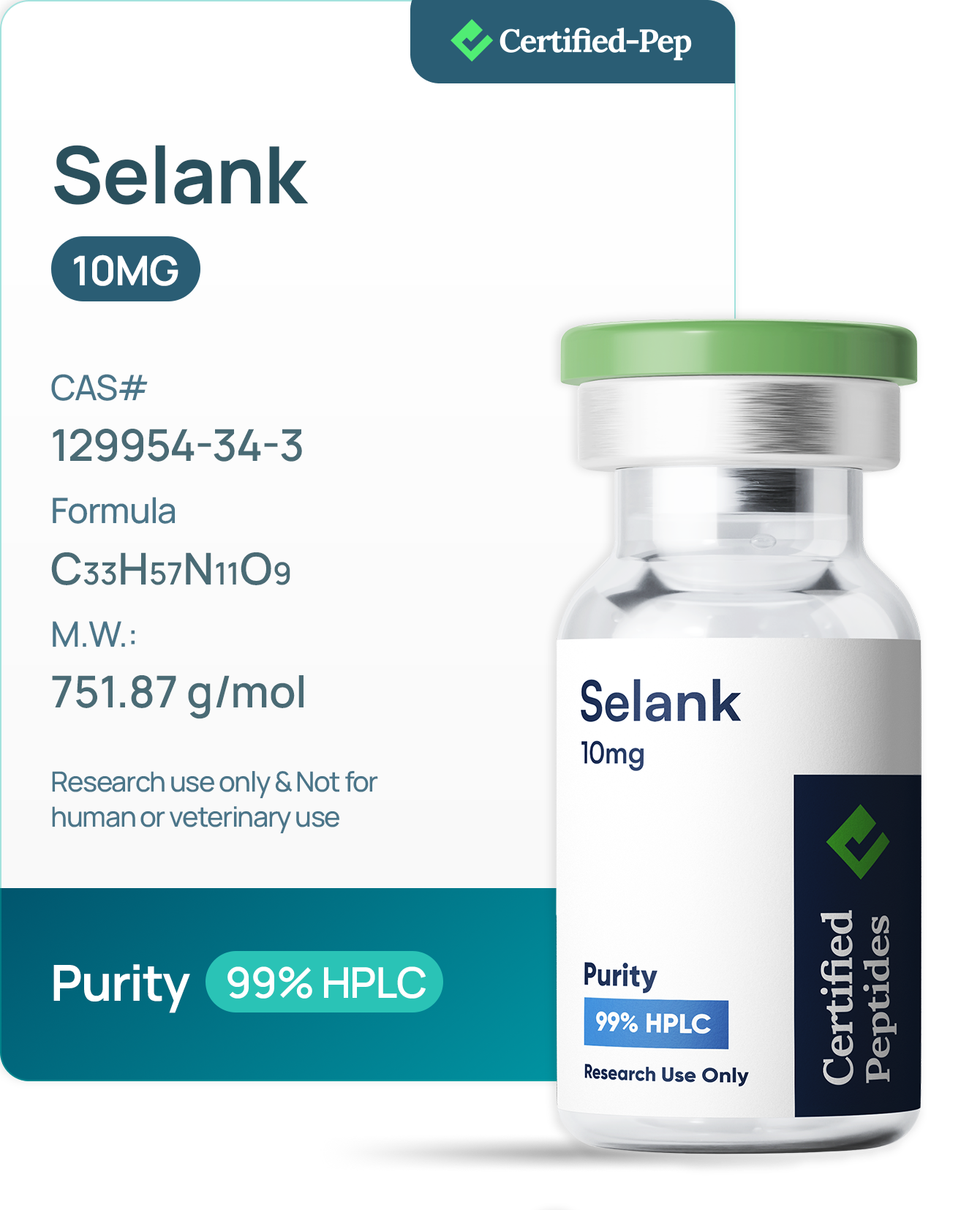
Selank is a synthetic peptide made of seven amino acids (Thr-Lys-Pro-Arg-Pro-Gly-Pro) with a molecular weight of about 751.9 g/mol. It was developed in Russia as an analog of tuftsin, a short fragment of immunoglobulin G. Laboratory work on Selank covers three areas: enzymes that break down enkephalins, expression of genes involved in GABA signaling, and expression of brain derived neurotrophic factor. Most pages about the Selank peptide describe it as a treatment. The published research describes something narrower, and this article walks through what each study measured, what it found, and where the evidence stops.
This page is written for researchers, lab managers and buyers who want the primary evidence behind the claims they see online. Certified-PEP sells Selank as a research-grade peptide for laboratory use only.
Selank at a Glance
- Sequence: Thr-Lys-Pro-Arg-Pro-Gly-Pro, a synthetic peptide derived from tuftsin
- Origin: developed at the Institute of Molecular Genetics, Russian Academy of Sciences, with the V.V. Zakusov Research Institute of Pharmacology
- Best-documented laboratory findings: inhibition of enkephalin-degrading enzymes in human serum, and changes in GABAergic gene expression in rat frontal cortex
- Human data: a small number of Russian clinical reports, none replicated in a Western trial
- Research status: preclinical work in rats and cells, plus a few small Russian clinical reports
- US regulatory status: Selank is not FDA approved
What Is Selank and Where Did It Come From?
Tuftsin is a naturally occurring immune peptide. It is a four-residue fragment (Thr-Lys-Pro-Arg) cut from the heavy chain of immunoglobulin G, and it was first studied for its effects on phagocytes. Tuftsin is a short, unmodified fragment, so it is cleared quickly and is hard to study over longer periods.
Selank solves that problem by adding three amino acids, Pro-Gly-Pro, to the end of the tuftsin sequence. Volkova and colleagues describe the added tail as a way to improve metabolic stability and prolong the compound’s duration of action. The result is a heptapeptide, the Selank peptide, that keeps the tuftsin core and is more stable than the parent peptide.
Selank came out of the molecular genetics and peptide chemistry groups in Moscow, which is why most of the primary literature appears in Russian-language journals. English-language papers on Selank are fewer, and most trace back to the same research group.
How Does Selank Work? Three Lines of Evidence
No single mechanism explains everything reported for the Selank peptide. Selank functions, as the papers describe them, center on the central nervous system and on peptide breakdown in serum. Three findings come up repeatedly, and each rests on a different kind of experiment.
Enkephalin-degrading enzymes
Enkephalins are short opioid peptides that the body clears with serum peptidases. Kost and colleagues tested Semax and Selank against enkephalin-degrading enzymes from human serum and found a dose-dependent effect. The abstract reports IC50 values of 10 µM for Semax and 20 µM for Selank, and says both were stronger inhibitors than puromycin and bacitracin. Pentapeptide fragments of the heptapeptides also inhibited the enzymes. Tri-, tetra- and hexapeptide fragments did not.
The authors suggest that slowing enkephalin breakdown could contribute to the biological activity of both peptides, because the same enzymes degrade other regulatory peptides. That is a proposal, not a demonstrated mechanism in a living brain, and the experiment used serum rather than neural tissue.
GABA receptors and gene expression
The most detailed English-language paper is Volkova et al. (2016) in Frontiers in Pharmacology, titled “Selank Administration Affects the Expression of Some Genes Involved in GABAergic Neurotransmission.” The design was narrow, so the details matter:
- Male Wistar rats, n = 30, split into control, Selank and GABA groups of 10
- A single intranasal dose of 300 µg/kg
- Frontal cortex taken at 1 hour or 3 hours
- A custom qPCR array covering 84 genes, with 77 analyzed after exclusions
- A cutoff of 1.5-fold change at p ≤ 0.05
At one hour, Selank raised Gabrb3 (about 1.6-fold) and lowered Gabre and Gabrq, along with the vesicular GABA transporter Slc32a1, the transporters Slc6a1 and Slc6a11, and the GABA-degrading enzyme Abat. At three hours the pattern reversed for several of them: Gabre rose roughly 16-fold and Gabrq roughly 13-fold, and Slc32a1, Slc6a1, Slc6a11 and Abat rose between about 1.5 and 2.3-fold.
The effects reported sit in the central nervous system, specifically the frontal cortex, and they bear on the stress response only indirectly. Two things stand out. Selank and GABA itself shifted many of the same genes in the same direction at one hour, which fits the authors’ hypothesis that Selank acts as an allosteric modulator of GABA A receptors. And the time course is messy, with early drops followed by large later increases, so a single snapshot would have told a different story depending on when the tissue was collected.
Brain derived neurotrophic factor
Inozemtseva et al. (2008) reported that intranasal Selank regulated BDNF expression in the rat hippocampus in vivo. Brain derived neurotrophic factor supports neuron survival and plasticity, and it appears in research on learning processes and memory processes. The study is short and, like the others, comes from the same research group. Volkova’s GABA paper does not discuss BDNF, so the two lines of work have not been tied together experimentally.
Some reviews also list changes in serotonin metabolism among Selank’s targets. We have not cited primary data for that here, so treat it as unconfirmed.
Effects of Selank in Laboratory Research
Most of what is described as the effects of Selank comes from rodent behavior and from gene or enzyme assays. Several themes appear across the literature.
Anxiolytic and anti anxiety effects in animal models
Selank is described in the Russian literature as a new peptide anxiolytic. Selank is called a peptide anxiolytic because of its behavior in rodent tests of anxiety and exploratory behavior. A rat study by Kasian et al. (2017) examined Selank alongside diazepam under unpredictable chronic mild stress, a model used to study the stress response. The paper reports that Selank changed the effect of diazepam in that model. Rodent anxiety tests are a weak proxy for human anxiety disorders, and results from them do not carry over to people.
Stress resilience and mood regulation
Secondary summaries of this work sometimes use phrases such as stress resilience and mood regulation. The measured outcomes in the underlying papers are behavioral scores and gene expression. Nobody measures mood in a rat, so those phrases are shorthand.
Cognitive function
The link between Selank and cognitive function rests mostly on the BDNF result above. Direct, well-controlled data on cognitive performance for Selank itself are thin. Some sources call Selank a cognitive enhancer. If you read a source that lists cognitive enhancement as an established property, check which experiment it is citing.
Selank and Immune Function
Selank inherits its structure from an immune peptide, so immune system function was one of the first things the Moscow groups checked, and immune modulation is still part of how the compound is described. A Russian clinical report examined immunomodulatory effects of Selank in patients with anxiety asthenic disorders (PMID 18577961). We have only been able to verify its title and indexing, not its full text, so we do not summarize its findings here.
For laboratory work, the relevant point is narrower. Tuftsin acts on immune cells, Selank keeps the tuftsin core, and there is a plausible reason to include immune system readouts in any study design. Plausible is not the same as shown.
Selank in Clinical Research
Clinical studies of Selank are few, and nearly all are Russian. The best-known human report is a Russian trial published in 2008 in Zhurnal Nevrologii i Psikhiatrii (PMID 18454096). It compared Selank with medazepam in 62 patients with generalized anxiety disorder or neurasthenia, 30 on Selank and 32 on medazepam. Anxiety was scored with the Hamilton, Zung and CGI scales. The authors reported similar anxiolytic effects in both groups, plus antiasthenic and psychostimulant effects for Selank. They also measured enkephalin degradation in blood serum and found that a baseline abnormality in leu-enkephalin half-life tracked with illness severity and shifted during Selank treatment.
That is the strongest clinical link between the enkephalin enzyme findings and an outcome. It is also a single, small, Russian-language study. Certified-PEP does not sell Selank for use in people, and nothing here should be read as a recommendation. The point of citing the trial is to show how far the human evidence extends.
Claims You Will See About Selank, and What Supports Them
Pages that sell Selank as peptide therapy repeat a consistent list: anti anxiety effects, anxiety relief, mental clarity, cognitive support, mood stability and better emotional regulation. Many add that it can reduce anxiety without the cognitive dulling associated with traditional medications such as benzodiazepines, and some bring up cognitive impairment or anxiety treatment.
Research suggests a narrower picture. The only head-to-head human report cited above is the 62-patient Russian trial, which compared Selank with medazepam on clinical rating scales. It did not measure mental clarity, mood stability or cognitive dulling in a way that supports those phrases. None of the papers reviewed here tested Selank in cognitive impairment. Treat each phrase as marketing language until you can name the paper behind it.
Other secondary claims are just as thinly sourced. Pages say Selank crosses the blood-brain barrier effectively, modulates noradrenergic and serotonergic systems, and causes only mild side effects such as headache, dizziness and nasal irritation. None of the papers cited above measured brain penetration, and none was designed to record side effects. Some pages also say Selank was once on an FDA list of bulk drug substances that may present significant safety risks. We could not verify that, so we do not rely on it.
What the Research Does Not Show
- Volkova et al. measured mRNA only. Protein levels and receptor function were not tested.
- The study used one dose, one route, one sex, one brain region and two timepoints, with samples pooled into six groups.
- The proposed allosteric effect on GABA A receptors is a hypothesis. The authors say more research is needed.
- The enkephalin enzyme work used human serum, not brain tissue.
- The clinical reports are small and come from one research tradition. No large Western trial has replicated them.
- There are no long term safety data. Nobody has published a multi-year safety record for Selank.
- Safety considerations remain open. Nothing in the cited papers says Selank presents significant safety risks, and nothing rules them out.
- Selank is not FDA approved, and the compound is not a medicine in the United States.
Selank Compared With Other Research Peptides
Selank appears alongside Semax in the enkephalin paper above, and the two were built in the same Moscow laboratories and share the Pro-Gly-Pro tail. Semax derives from an ACTH fragment, Selank from tuftsin, and the BDNF literature leans more heavily on Semax. If you are working with both, our Semax vs Selank comparison covers the differences, and the Selank/Semax 10/10mg blend is available as a single research vial.
Frequently Asked Questions
Is Selank the same as tuftsin?
No. Tuftsin is the four-residue fragment Thr-Lys-Pro-Arg. Selank adds Pro-Gly-Pro at the end, which makes it a seven-residue synthetic peptide with a longer lifespan in biological fluids.
Why is Selank not FDA approved?
No sponsor has completed the US drug approval process for it. The clinical reports that exist are Russian studies of modest size. FDA status is a regulatory fact, not a verdict on the compound, and it means Selank can only be sold in the United States for laboratory research.
Does Selank cause side effects?
Published safety information is limited. The studies cited here were not designed to catalogue adverse effects, and no long term safety data exist. Certified-PEP does not offer guidance on use in people.
Who should not use Selank?
Certified-PEP products are not for human or veterinary use at all. Selank is a laboratory reagent.
What forms does Selank come in for research?
In the rat studies, Selank administered intranasally was dissolved in solution, and the Volkova study used 300 µg/kg that way. Online listings also describe a Selank nasal spray and injectable Selank. Certified-PEP sells neither as a finished product. Our catalog lists Selank as a lyophilized research peptide, and the Selank peptide in that form is a laboratory reagent.
Sourcing Selank for Laboratory Research
Certified-PEP supplies Selank 10 mg as a lyophilized research peptide, made in the USA. Every lot ships with a certificate of analysis from an ISO/IEC 17025 laboratory, and you can read the results on our COA page and the lab testing page. For identity and purity reasons, check the COA against the lot number on your vial before starting any assay. Our Selank FAQ covers storage and handling questions, and the research purposes only page explains how we classify our products.
Where Researchers Get Selank
Selank for Research Use
References
- Volkova A, Shadrina M, Kolomin T, Andreeva L, Limborska S, Myasoedov N, Slominsky P. Selank administration affects the expression of some genes involved in GABAergic neurotransmission. Front Pharmacol. 2016;7:31. doi:10.3389/fphar.2016.00031
- Kost NV, Sokolov OIu, Gabaeva MV, Grivennikov IA, Andreeva LA, Miasoedov NF, Zozulia AA. Semax and selank inhibit the enkephalin-degrading enzymes from human serum. Bioorg Khim. 2001;27(3):180-183. PMID 11443939
- Inozemtseva LS, et al. Intranasal administration of the peptide Selank regulates BDNF expression in the rat hippocampus in vivo. Dokl Biol Sci. 2008;421:241-243. PMID 18841804
- Kasian A, et al. Peptide Selank enhances the effect of diazepam in reducing anxiety in unpredictable chronic mild stress conditions in rats. Behav Neurol. 2017;2017:5091027. PMID 28280289
- Efficacy and possible mechanisms of action of a new peptide anxiolytic selank in the therapy of generalized anxiety disorders and neurasthenia. Zh Nevrol Psikhiatr Im S S Korsakova. 2008;108(4):38-48. PMID 18454096
- Immunomodulatory effects of selank in patients with anxiety-asthenic disorders. PMID 18577961
Research use only
Certified-PEP products are sold for laboratory research only. They are not drugs, foods, cosmetics or dietary supplements, and they are not for human or veterinary use. Nothing in this article describes effects in people or offers guidance for use in people.