
What Is BAM15? A Mitochondrial Uncoupler Explained Through the Research
What is BAM 15? It is a small synthetic molecule that makes mitochondria burn fuel without making as much ATP. Researchers call that mitochondrial uncoupling, and BAM15 is one of the best-studied uncouplers to appear in the last decade. Studies in cells and mice link it to higher oxygen consumption, less fat gain and better insulin action. No study has tested it in people.
This article explains how the compound works, what each major study measured, and where the evidence stops. It is written for laboratory research context only. BAM15 is a research compound. It is not approved for human use, and nothing below is advice for use in people. For a short definition first, see our peptide FAQ.
What Is BAM 15 at a Glance
- BAM15 is a synthetic mitochondrial uncoupler. It lets protons leak across the inner mitochondrial membrane, which raises oxygen consumption and lowers ATP made per unit of fuel.
- In diet induced obesity models, mice given BAM15 gained less fat. Food intake, lean mass and body temperature did not change in the main mouse study.
- Insulin resistance improved in mouse and cell studies, with lower liver fat and better glucose handling reported.
- Older uncouplers such as dinitrophenol were toxic. BAM15 does not depolarize the plasma membrane, which is why researchers see it as a safer tool.
- Every finding comes from cells or animals. There are no human trials, and long term safety is unknown.
What Is BAM 15? Cellular Energy Metabolism and the Mitochondrial Uncoupler BAM15
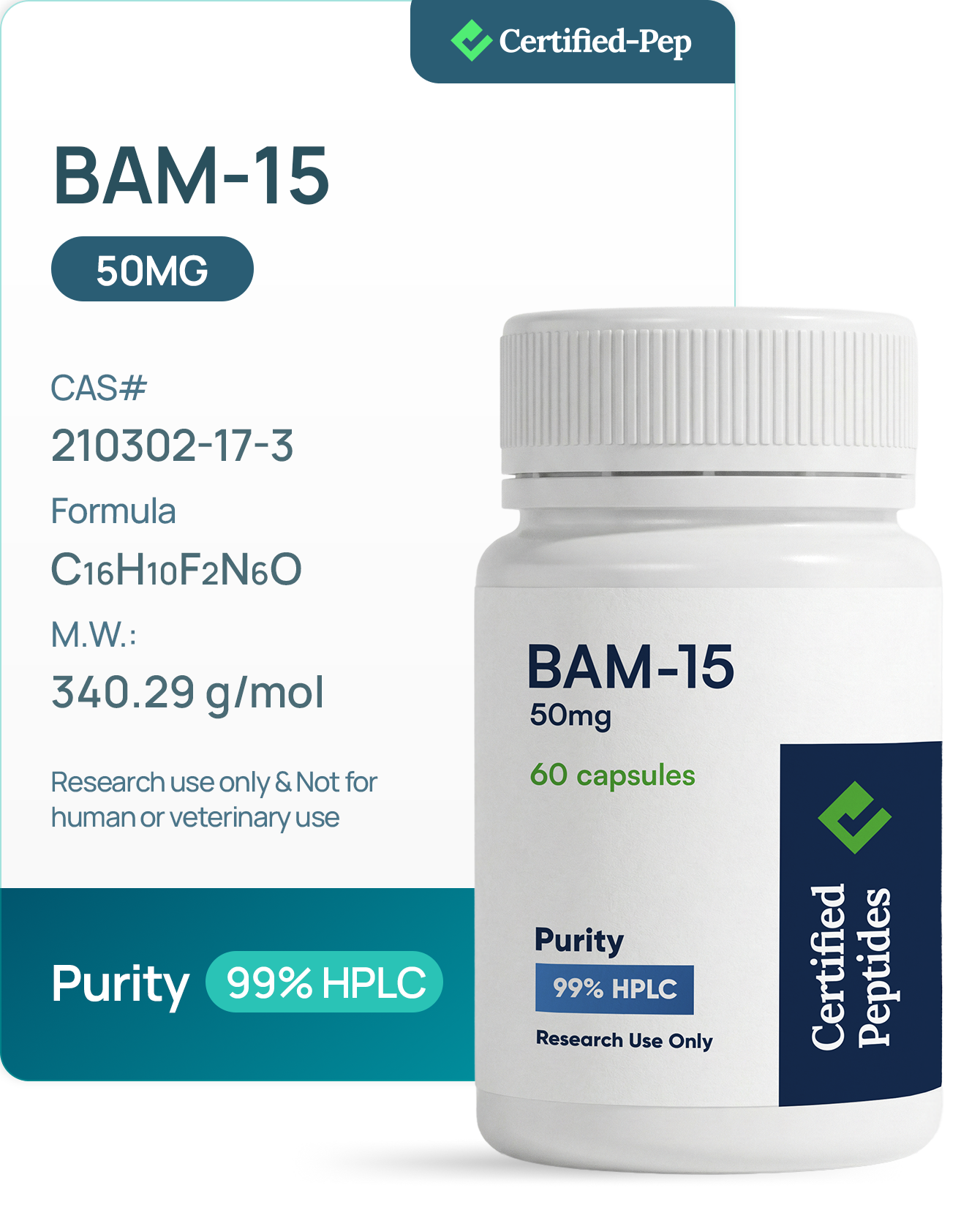
BAM15 is a mitochondrial uncoupler built on a pyrazine ring system. Its chemical name is (2-fluorophenyl){6-[(2-fluorophenyl)amino][1,2,5]oxadiazolo[3,4-e]pyrazin-5-yl}amine, and it has a molecular weight of about 340 g/mol. Kenwood and colleagues found it in a screen for a new mitochondrial uncoupler that would avoid the toxicity of older compounds.[1]
Mitochondria are the subcellular organelles responsible for most cellular energy production. They turn food into ATP through a chain of steps. An uncoupler interrupts the link between those steps. A mitochondrial uncoupling agent derived from a screen, like BAM15, is called a protonophore because it carries protons across a membrane that normally blocks them.
The result is a cell that works harder to make the same energy. That change in cellular energy metabolism is why researchers study the compound in obesity, diabetes, liver disease and muscle aging. So when someone asks what is BAM 15 in one line, the answer is a tool for modulating cellular energy metabolism in the lab.
Energy Metabolism and Mitochondrial Uncoupling: Oxidative Phosphorylation Explained
Oxidative phosphorylation is the process that makes most of a cell’s ATP. It has two linked halves.
First, the electron transport chain moves electrons along a series of protein complexes in the inner mitochondrial membrane. As electrons move, the complexes pump protons out of the matrix. That builds a proton gradient, a bit like water stored behind a dam.
Second, ATP synthase lets protons flow back in through a channel. The flow powers the making of ATP. In a coupled mitochondrion, electron flow and ATP production move together.
BAM15 breaks the link. It raises the permeability of the inner mitochondrial membrane to protons, so some protons skip ATP synthase and leak back across. The chain then runs faster to rebuild the gradient. Researchers describe this as mild mitochondrial uncoupling. Oxygen consumption goes up, and more of the fuel ends up as heat instead of ATP.
That is why BAM15 is described as a compound that disrupts coupling between electron transport and ATP synthesis. It does not block the chain. It mildly inhibits mitochondrial respiration in the sense that ATP output falls, while the chain itself speeds up. Energy metabolism shifts toward fuel burning and away from storage.
Mitochondrial Respiration and Oxygen Consumption
The first test of any uncoupler is simple. Does it raise oxygen consumption, and does it do so without killing the cell?
In the original screen, BAM15 raised oxygen consumption in cultured cells and produced a higher maximal mitochondrial respiration than FCCP, a standard lab uncoupler, at comparable potency.[1] It also showed lower cytotoxicity in the same comparison. BAM15 was also active in mice, where it protected kidney tissue from ischemia-reperfusion injury in a dose dependent way.[1]
The detail that set it apart was the plasma membrane, and it explains why BAM15 counts as a selective mitochondrial uncoupling agent. FCCP and dinitrophenol move protons across any membrane they reach. That includes the plasma membrane, and the effect disrupts ion balance and cell signaling. BAM15 does not appear to depolarize the plasma membrane in the same way. The paper reported that it acts mainly on mitochondria. This is a point of selectivity, not a guarantee of safety, and studies of influencing plasma membrane depolarization in other cell types have been limited.
Later work expanded the range of models. Experiments used isolated rat liver mitochondria to measure respiration directly, and cultured rat brain astrocytes to test effects in non-liver cells. Some reports in other cell types describe that BAM15 increases intracellular calcium concentration at high exposure, which suggests that the effect depends on the dose and the cell. These details matter for lab design because a result in one system may not carry to another.
BAM15 Reverses Diet-Induced Obesity in Mice
The study that put BAM15 on most readers’ radar came from Alexopoulos and colleagues at the University of Virginia and Penn State. Its title states the result: BAM15 reverses diet induced obesity and insulin resistance in mice.[2]
Mice were fed a high-fat diet and then given BAM15. The main findings were as follows.
- BAM15 was orally bioavailable in mice and increased nutrient oxidation.
- It reduced body fat without altering food intake, and it left lean body mass and body temperature unchanged.
- It showed no signs of biochemical or hematological toxicity in the tests the authors ran.
- Liver fat and inflammatory lipids fell, and the authors described antioxidant effects.
- Hyperinsulinemic-euglycemic clamp studies showed better insulin sensitivity across several tissue types.
The combination matters. A drug that cuts weight by cutting appetite is a different tool from one that raises energy expenditure. In this study, the mice ate about the same amount of food. The change came from how they used fuel. That finding is the reason mild uncoupling keeps returning in discussions of metabolic diseases.
The effect on body weight also needs context. Reported weight and fat changes were measured in mice on a defined diet, over a set number of weeks. Translating them to other species, other diets or longer periods is not straightforward. A mouse that prevents fat mass gain is not a person who loses weight.
A second paper from the same research group, by Axelrod and colleagues, reported that BAM15 mediated mitochondrial uncoupling protects against obesity and improves glycemic control.[3] In cells, it improved mitochondrial respiration, enhanced insulin action and raised nutrient uptake through sustained AMPK activation. In mice on a high-fat diet, it increased energy expenditure and protected against weight gain. Glucose control also improved apart from weight loss, which the authors partly attribute to the compound accumulating in lipid-rich tissues.
Pharmacokinetics in mice
Published pharmacokinetic work in mice reports an oral bioavailability of about 67% and a half-life of about 1.7 hours. A short half-life in mice means exposure falls quickly, and species differ. Those numbers describe mice. No human pharmacokinetic study exists.
Why Researchers Ask What Is BAM 15 Doing Differently
Many people meet the compound through a product page and ask what is BAM 15 in plain terms. The research answer has three parts. It is an uncoupler, which changes how mitochondria spend fuel. It is selective for mitochondria in the data published so far. And it has been tested in mice, not in people. Each part matters when you read a claim. A source that skips the third part is describing hope, not evidence.
It also helps to separate three ideas that blur together online. Uncoupling raises energy use. Fat loss is a downstream result seen in some mouse models. Health benefit is a further step that no human study has measured. Moving from the first idea to the third without data is how headlines outrun research.
Insulin Resistance and Glucose Metabolism
Insulin resistance is a state in which tissues respond poorly to insulin. Its pathogenesis involves insulin resistance across muscle, liver and fat, and it sits behind type 2 diabetes and many chronic metabolic disease states. That makes glucose metabolism a natural endpoint for uncoupler research.
The mouse data fit a clear pattern. In the clamp studies, BAM15 improved insulin action in several tissues.[2] In diabetes models, reports describe better glycemic control, including in db/db mice, a strain with severe obesity and diabetes. Some work found lower glucagon secretion and a reduced pancreatic alpha cell mass, a change that could ease high blood sugar by lowering glucose production by the liver. Hepatic glucose output was also lower in several reports. These are preclinical findings, and some come from a single lab.
The proposed mechanism runs through energy stress. When ATP supply falls, the enzyme AMPK switches on. AMPK acts as a cellular fuel gauge. Its activation raises glucose uptake and fatty acid oxidation. In the Axelrod work, sustained AMPK activation explained part of the improved insulin action in cells.[3] Researchers also describe novel mitochondrial uncoupling as a way of facilitating mitochondrial uncoupling without the cell damage that older drugs caused.
Mitochondrial Biogenesis and Gene Expression
Researchers also describe changes in mitochondrial biogenesis regulation. One report links BAM15 to higher activity of PGC-1 alpha, a regulator of new mitochondria. Another describes a rise in mitochondrial gene expression after treatment. In liver, enhancing mitochondrial biogenesis could mean more working mitochondria per cell, and reports of liver mitochondrial biogenesis in treated mice fit that idea. One review proposed that BAM15 activates mitochondrial transcription, which would help cells build more of the machinery.
These links suggest that uncoupling may do more than burn fuel. A treated cell may sustain higher respiration by making more mitochondria, not only by leaking protons. One review says BAM15 promotes mitochondrial respiration this way, and another says it boosts mitochondrial respiration under load. Studies in muscle and liver describe the same direction, which is better mitochondrial function and a stronger capacity to boost mitochondrial respiration under load. Some papers describe enhancing mitochondrial respiration as the main outcome. The idea needs more testing, and one lab’s gene panel is not a settled mechanism.
Mitochondrial Dysfunction and Metabolic Disorders
Mitochondria are essential subcellular organelles responsible for turning food into usable energy. They also run signaling, calcium handling and cell death programs. Abstract subcellular organelles dysfunction sounds remote, but it has concrete forms. Impaired mitochondrial function appears in obesity, type 2 diabetes, fatty liver, muscle wasting, heart failure and sepsis. Mitochondrial dysfunction is a term encompassing metabolic disorders characterized by poor fuel use, high oxidative stress and weak repair. These are chronic metabolic disease states, and they often overlap in one patient.
That overlap is what makes the topic attractive. The same organelle sits behind many diverse energy synthesis pathways, so a lever on the organelle might move several problems at once. Researchers are interested in mitigating mitochondrial dysfunction by tuning how tightly mitochondria couple fuel burning to ATP. They also ask whether such tuning could potentially alleviate oxidative stress. These are questions, and mouse data are the first step toward an answer.
Selective Targeting and Its Limits
A recurring theme is selectivity. A novel mitochondrial uncoupler has two jobs. It has to act on mitochondria, and it has to avoid other membranes. Some reviews credit BAM15 with heightened mitochondrial targeting efficiency compared with older compounds. In plain terms, more of the compound ends up where the researcher wants it. Reviewers call it a novel mitochondrial uncoupling agent for that reason, and the label stresses selectivity over raw potency.
Selectivity cuts both ways. One line of work asks whether selectively targeting tumor cells with uncouplers could stress cancer metabolism. This is a lab idea, not a therapy. Mitochondrial uncoupling induced at high exposure can also disrupt mitochondrial function in healthy cells. Disrupting mitochondrial function is the intended act of an uncoupler, and in a healthy cell it can go too far. Off-target effects at high concentrations are a further concern. A selective mitochondrial uncoupling agent is still a drug-like molecule with limits.
Fatty Liver Disease and Liver Fat
Fatty liver disease is a build-up of fat in liver cells. Nonalcoholic fatty liver disease (NAFLD) is the common form, and it is closely tied to insulin resistance and obesity. Mitochondria in fatty liver often work poorly, and reactive oxygen species rise.
Mouse studies suggest that mitochondrial uncoupling can lower liver triglyceride levels. The Alexopoulos study reported lower liver fat and fewer inflammatory lipids in obese mice.[2] Other reports describe lower liver triglycerides in diabetic mice at higher doses, improved liver enzymes and less inflammation in NASH models. They also describe less oxidative stress through lower production of reactive oxygen species. One appeal of the approach is that it does not seem to depend on changes in food intake.
These results come from models. A mouse model of fatty liver is not human disease, and none of this has been tested in a clinical trial.
Skeletal Muscle Mitophagy and Sarcopenic Obesity
Muscle is another focus. Older adults with obesity can lose muscle mass and strength at the same time, a state called sarcopenic obesity.
Dantas and colleagues tested BAM15 in 80-week-old male mice with obesity.[4] The mice ate a high-fat diet with or without BAM15 for 10 weeks. In the treated group, body weight fell from 54.0 g to 42.3 g, and muscle mass as a share of body weight rose from 52.7% to 59.4%. Grip strength rose from 91.1 g to 124.9 g, and locomotor activity increased.
The molecular data pointed to quality control. The authors reported higher markers of mitophagy, the process that clears damaged mitochondria. These included more PINK1 ubiquitin binding and a rise in LC3-II. Citrate synthase and complex II activity rose, and markers of muscle inflammation, endoplasmic reticulum stress and apoptosis fell. The paper, published in the J Cachexia Sarcopenia Muscle journal, argued that enhancing skeletal muscle mitophagy may offset age related muscle loss. Cachexia, sarcopenia and muscle wasting are the wider setting.
Related reviews describe uncouplers as agents that influence several mitochondrial quality control processes at once, such as mitophagy and the balance of fission and fusion. Mitochondrial fission proteins and a mitochondrial fusion protein control how mitochondria divide and merge. Some work suggests that high exposure can impair mitochondrial autophagy, and others find that low exposure helps. That split is a reason for care. It is also a reminder that effects depend on dose.
One more caution: the muscle results come from one mouse strain, one sex and one lab. Studies in male and female subjects may differ, and the original paper tested only males.
Inflammation, Sepsis and Kidney Injury
Sepsis involves immune dysfunction after infection, and the kidney is often hit. Tsuji and colleagues at the NIH tested BAM15 in a mouse sepsis model.[5] Giving 5 mg/kg by intraperitoneal injection at the time of surgery raised seven-day survival from about 25% to 75%. Treatment later still helped, but less.
The study linked the benefit to mitochondrial DNA. Circulating and urinary mitochondrial DNA rose in sepsis and fell with BAM15. BAM15 also reduced septic acute kidney injury, lowered oxidative stress in the kidney and cut neutrophil death. When neutrophils were removed, the benefit disappeared. The authors suggest a drug and biomarker pair, with mtDNA as the marker, but say the idea is untested in people.
Other reports link uncoupling to suppressing inflammation mitochondrial DNA release drives. Inflammation mitochondrial DNA triggers is a growing topic in sepsis and aging work. When mitochondrial DNA leaks out of damaged cells, it can trigger inflammation, so lowering that leak may calm the response. A cell that has uncoupled mildly may also facilitate mitochondrial uncoupling in neighboring tissue through shared signals, though that remains a hypothesis. Some work also describes an effect on how macrophages shift between inflammatory and repair states, in line with changes that regulates macrophage polarization genes. In muscle, the Dantas data included alleviating endoplasmic reticulum stress. These findings are early.
Cardiovascular Research
Mitochondrial dysfunction is a feature of many cardiovascular diseases. High membrane potential pushes the electron transport chain to produce more mitochondrial reactive oxygen species, and mild uncoupling lowers that output. Researchers have asked whether the same logic can protect heart tissue by lowering oxidative stress.
Early cell and animal work has reported cardioprotective effects and changes in inflammatory signaling, including lower activity of the NLRP3 inflammasome in some models. Studies in heart muscle cells have described a biphasic effect on STAT3, which means low and high exposure move it in different directions. The details are mixed, and the work is small. Treat these reports as leads. They do not show that the compound helps a failing heart.
Mitochondrial Reactive Oxygen Species and Oxidative Stress
A recurring idea in this field is that mild uncoupling can reduce oxidative stress. When the proton gradient is very high, electrons stall and leak, and mitochondria make more superoxide. A small leak across the membrane lowers that pressure.
Several studies report decreased mitochondrial superoxide production with BAM15 and lower levels of reactive oxygen species in treated cells. The Alexopoulos paper described antioxidant effects in mice.[2] This is the usual reason given for benefits in liver, muscle and kidney. The theory is attractive and fits the data, but it is a mechanism proposed to explain results, not a proven chain of cause.
How BAM15 Compares With Older Uncouplers
| Feature | 2,4-dinitrophenol | FCCP | BAM15 |
|---|---|---|---|
| Use | Historic weight-loss drug, now banned | Standard lab reagent | Research compound |
| Plasma membrane effect | Depolarizes | Depolarizes | Does not depolarize in the original study |
| Cell toxicity | High | High past a narrow range | Lower in the original comparison |
| Body temperature in animals | Raises it, with fatal cases | Not used in vivo | No rise reported in the main mouse study |
| Human trials | Harmful, withdrawn in the 1930s | None | None |
Dinitrophenol shows why this field is cautious. It killed people through toxic hyperthermia in the 1930s. BAM15 is not dinitrophenol. It does not cause the same temperature rise in mice at the doses tested. But a safer profile in a mouse is not proof of safety in a person, and uncoupling by nature has a narrow margin. Too much can drain cellular energy supply and damage tissue.
What Is BAM 15 Compared With Other Metabolic Research Compounds?
BAM15 is a small molecule that acts inside the cell. Hormone-based compounds act on receptors on the cell surface. GLP-1 and amylin analogs change appetite and gut signals, so mice treated with them eat less. BAM15 left food intake alone in the main obesity study. AMPK activators, by contrast, mimic low energy supply, while an uncoupler creates it by leaking protons. Each route can reach similar endpoints, such as lower liver fat, by different paths. That difference is useful in a lab, because it lets a researcher test whether an effect depends on appetite, on energy use or on both.
What BAM15 Research Does Not Show
- No human trials. Human efficacy, safety and pharmacokinetics are unknown, and long term safety data do not exist.
- No dose range for people. This article gives none.
- Mostly mouse data. Findings in other species and other diets are limited.
- Mixed results across tissues and doses. Some effects flip with the amount of exposure.
- Short studies. Most ran for weeks. Chronic exposure data are thin.
The honest summary is narrow. BAM15 is a well-characterized tool for studying mitochondrial uncoupling in cells and animals. It is not a treatment, and it has not been shown to help any condition in people.
Designing a BAM15 Study
Good design starts with controls. A few points repeat across the literature.
- Housing temperature changes how much heat a mouse already makes, so it shifts the baseline.
- Diet composition, age and sex all affect results. Studies should include male and female subjects.
- Oxygen consumption assays need dose titration. Uncouplers raise respiration up to a point and then suppress it.
- Citrate synthase or mitochondrial DNA copy number helps separate more mitochondria from more active ones.
- Body temperature and clinical chemistry are the first safety readouts for any uncoupler.
For handling after delivery, see how to store peptides. BAM15 is light sensitive, so store it sealed, cold and dark. To check a batch, match it to its report in the COA library. Our guide to peptide purity explains how to read a COA.
Sourcing BAM15 for Laboratory Research
Certified-PEP offers BAM 15 50mg for laboratory research use. It is made in the USA. An ISO/IEC 17025 third-party laboratory tests each lot for HPLC purity and identity, and every lot ships with a COA. Read the research purposes only policy before you order.
Research BAM-15
What Is BAM15? FAQ
What is BAM 15?
BAM15 is a synthetic mitochondrial uncoupler. It lets protons leak across the inner mitochondrial membrane, which raises oxygen consumption and lowers ATP made per unit of fuel.
Is BAM15 a peptide?
No. It is a small molecule, not a chain of amino acids. It sits in the same research space as peptides, which is why it appears in the same catalogs.
How does BAM15 differ from DNP?
BAM15 did not depolarize the plasma membrane in the original study, and mice given it showed no rise in body temperature. Dinitrophenol caused toxic hyperthermia in people.
What did the main mouse study find?
BAM15 reduced fat mass and improved insulin sensitivity without changing food intake, lean mass or body temperature in obese mice.[2]
Is BAM15 approved for people?
No. It is classified as a research compound. It has not been through human trials.
Where can I see batch testing?
Reports are in the COA library, and the lab testing page lists the panel.
References
- Kenwood BM et al. “Identification of a novel mitochondrial uncoupler that does not depolarize the plasma membrane.” Mol Metab. 2014;3(2):114-123. doi:10.1016/j.molmet.2013.11.005
- Alexopoulos SJ et al. “Mitochondrial uncoupler BAM15 reverses diet-induced obesity and insulin resistance in mice.” Nat Commun. 2020;11(1):2397. doi:10.1038/s41467-020-16298-2
- Axelrod CL et al. “BAM15-mediated mitochondrial uncoupling protects against obesity and improves glycemic control.” EMBO Mol Med. 2020;12(7):e12088. doi:10.15252/emmm.202012088
- Dantas WS et al. “Mitochondrial uncoupling attenuates sarcopenic obesity by enhancing skeletal muscle mitophagy and quality control.” J Cachexia Sarcopenia Muscle. 2022;13(3):1821-1836. PubMed
- Tsuji N et al. “BAM15 treats mouse sepsis and kidney injury, linking mortality, mitochondrial DNA, tubule damage, and neutrophils.” J Clin Invest. 2023;133(7). JCI
Research use only
Certified-PEP products are sold for laboratory research only. They are not drugs, foods, cosmetics or dietary supplements, and they are not for human or veterinary use. Nothing in this article describes effects in people or offers guidance for use in people.