
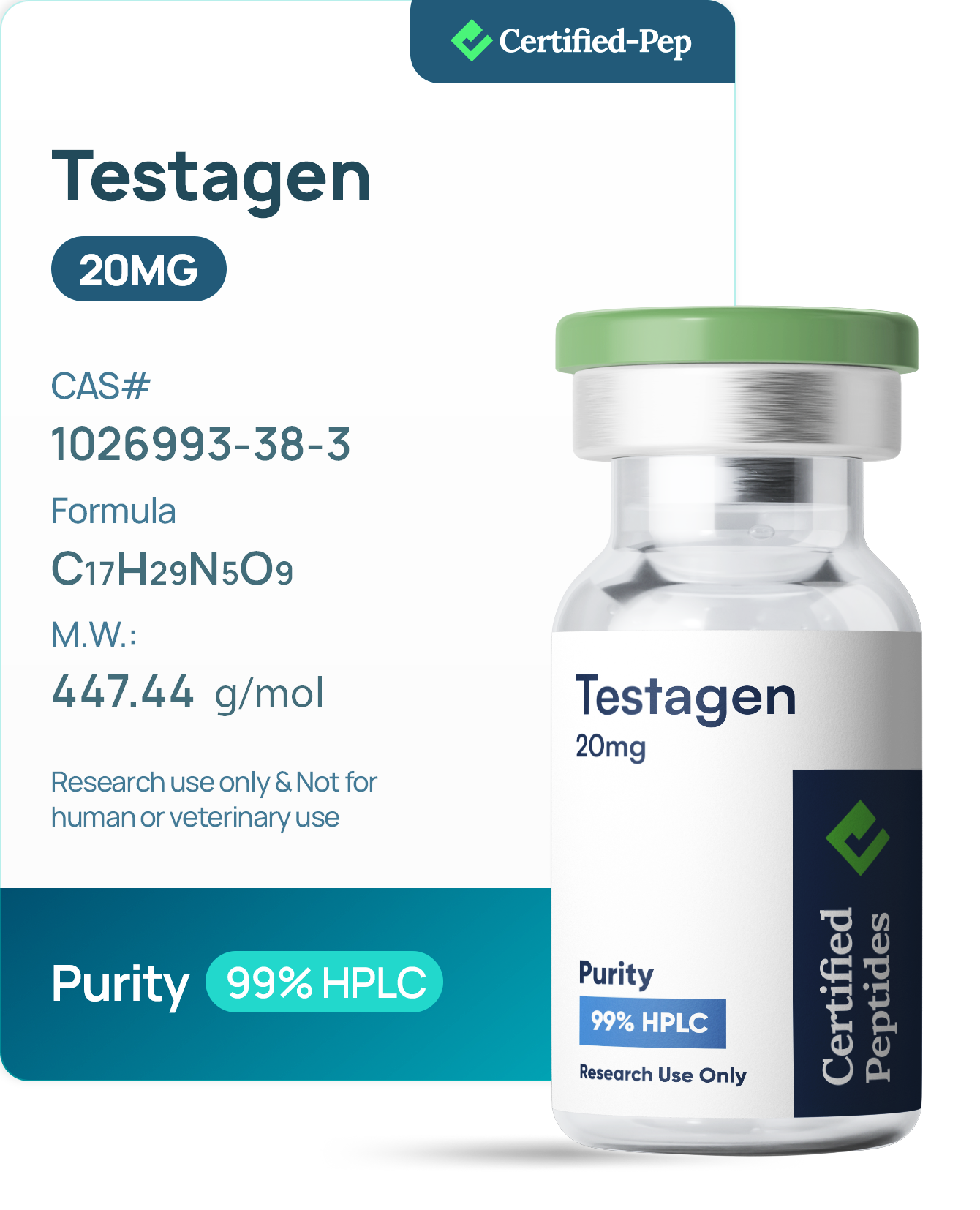
Testagen
20mg
- Ships same or next day Orders before 3PM EST, FedEx 2-Day Air
- Verify this lot View the lab reports · View the Vanguard certificate
- Real U.S. support Live chat and email, 7 days a week
For research use only. Not for human or veterinary consumption.
Testagen peptide: a KEDG tetrapeptide
Testagen is a short synthetic peptide of four amino acids: lysine, glutamic acid, aspartic acid and glycine, written Lys-Glu-Asp-Gly and shortened to KEDG. Its molecular weight is 447.44 g/mol and its formula is C17H29N5O9. A figure of 419 Da circulates on vendor pages and does not match that sequence, so check the number against the lot report rather than against a listing.
It belongs to the line of bioregulator peptides developed at the St Petersburg Institute of Bioregulation and Gerontology under Professor Vladimir Khavinson. That research tradition began with tissue extracts, where a gland was processed and its peptide fraction tested. Testagen is the synthetic stand-in for the fraction linked to testicular tissue. As a research peptide it is sold on the strength of that model rather than of its own data. This vial holds 20 mg for laboratory research.
Short peptides, gene expression and the peptide bioregulators idea
The whole family rests on one proposal: that peptides this small can slip through cell and nuclear membranes, reach the nucleus and interact directly with DNA, switching particular genes on or off. Khavinson's group calls this epigenetic regulation, and it is the proposed mechanism behind every one of these compounds [1].
There is some support for the first half. Fedoreyeva and colleagues labeled several short peptides with a fluorescent tag, watched them enter the nucleus and nucleolus of HeLa cells, and showed that they bound specific deoxyribooligonucleotides in vitro [2]. Work in human mesenchymal stem cell cultures reported shifts in aging-related gene expression after exposure to short peptides [3]. That is the cell-level case for the model, and it is thinner than the marketing suggests. Independent groups outside the Russian network have rarely tested it, and none of this work is about KEDG in particular.
How Khavinson peptides are proposed to work on the reproductive axis
Testosterone production runs on a chain. The hypothalamus signals the anterior pituitary gland, the pituitary releases LH, and LH tells Leydig cells in the testes to make testosterone. The chain as a whole is the hypothalamic pituitary gonadal axis, and vendor descriptions of how Testagen works place it there, and the Testagen bioregulator is marketed on that chain. The claim is that it normalizes pituitary signaling and supports Leydig cell activity and testosterone biosynthesis, rather than supplying a hormone from outside.
Read as a hypothesis, that is coherent. A signaling molecule that nudges gene expression in testicular tissue would in principle affect testosterone synthesis without acting as testosterone. The problem is what comes next: nobody has published the experiment.
Does Testagen increase testosterone?
No study we could find answers that. Searching the indexed literature for KEDG turns up nothing on testosterone levels, male reproductive endpoints, testicular function, spermatogenesis or sperm counts. The reference lists on vendor pages do cite papers, but they give a title and a journal with no authors, and the papers do not come up when searched. Count those citations as unverified.
So the honest answer is that no controlled human trials, registered clinical trials or animal models published in English have measured whether Testagen increases testosterone. There is no efficacy data to weigh. Claims that it does work are extrapolation from the bioregulator framework, not findings.
Testosterone, natural production and hormonal balance claims
Online, Testagen is sold for men's health and marketed as a natural testosterone booster. The pitch covers age-related decline in older men, better hormonal balance, improved libido, sexual performance, mood, vitality, fertility and prostate health. Claims about inflammation and metabolic health are often combined with those. Some pages describe it as supporting the body's natural production rather than replacing it, which is the line that separates it from drugs and from hormone supplements in that marketing.
None of those outcomes has been measured in a trial. Testosterone in people moves with sleep, body composition, illness, medications and age, so attributing a change to one compound takes a controlled study, and none exists here. This page makes no claim about reproductive function, testicular function or any aspect of health in people.
What peptide research actually exists
Here is the full picture, so researchers can judge it for themselves. The published work is about short peptides as a class, in cell culture: nuclear entry, interacting with DNA, and shifts in gene expression [1][2][3]. The tissue-extract preparations that preceded the synthetic peptides have their own small Russian literature. KEDG itself has essentially no independent record in experimental biology.
That makes Testagen a reasonable probe for anyone studying the bioregulator model, and a poor basis for a claim. Understanding Testagen starts with accepting how little has been done.
Is Testagen safe, and is it FDA approved?
Testagen is not FDA approved as a therapeutic drug, and it has no approved use anywhere we could confirm. It is sold as a research chemical, and purity and identity vary between suppliers, which is the first of the practical concerns. The second is that its full safety profile is unknown. Anecdotal reports mention injection site reactions and hormonal fluctuations; there is no trial evidence, no dose range established in people, and no long-term data. Anything acting on hormones raises questions in anyone with a hormone-sensitive condition. This page gives no dose, schedule or route, and the material is not for human use.
Related peptides in the bioregulator line
Each peptide in the set carries a different short sequence and a different tissue assignment. Epithalon is AEDG, tied to the pineal gland and studied for telomerase in cell cultures. Cartalax is AED, tied to cartilage. Pinealon is EDR. The evidence behind each varies, and all of them share the same gap between the model and the outcome data.
For researchers working on the same axis from a different angle, Kisspeptin-10 acts upstream at the hypothalamus and HCG 5000 IU mimics LH at the Leydig cell receptor. Both have real published pharmacology, which makes them useful comparators.
Quality testing and storage
Certified Peptides manufactures in a cGMP facility in Texas. Each batch goes to an ISO/IEC 17025 accredited US lab for purity (HPLC), quantity, identity (LC-MS), endotoxins, heavy metals and sterility testing. For a compound with no reference literature, the lot report is the only thing that tells you what is in the vial, so read it. When you order Testagen, match the QR code to its report in the COA Library. Lab Testing explains the methods. Keep it sealed, cold and out of the light.
Questions researchers ask
What does the KEDG sequence tell you about the peptide?
Two of its four residues, glutamic and aspartic acid, carry negative charges, and lysine carries a positive one. That mix is what the DNA-binding model leans on, since charged side chains are how a small molecule would grip a nucleotide sequence. It also makes the peptide water-soluble and easy to make by standard solid-phase synthesis.
How would researchers test the gene expression claim?
The direct route is a cell line that expresses the genes of interest, exposed to the peptide, with RNA sequencing or qPCR as the readout and a scrambled-sequence control. Leydig cell lines such as MA-10 would suit the testosterone question, measuring steroidogenic enzymes and steroid output. Nobody has published that experiment with KEDG.
Why are the bioregulator peptides so hard to verify?
Most of the work was published in Russian-language journals or in Bulletin of Experimental Biology and Medicine, often by one institute, frequently without blinding. Western reviewers weight independent replication heavily, and there has been very little. The model is not disproven; it is untested outside its origin.
How does Testagen differ from a testicular tissue extract?
An extract contains many peptides and proteins from the tissue, so an effect cannot be traced to one component. Testagen is a single defined tetrapeptide. Results from the extract do not carry over to the synthetic peptide, and the two should not be cited as one body of evidence.
What should a first study record?
Lot number, COA results, solvent, concentration and storage, alongside whatever endpoints are being measured. With no published methods to follow, the methods section is doing more work than usual, and anyone repeating the work later will need all of it.
Disclaimer
For laboratory research use only. Not for human or veterinary use. Not for consumption. This product is not a drug, food or cosmetic. Information on this page is for educational purposes, has not been evaluated by the FDA, and is not intended to diagnose, treat, cure or prevent any disease.
References
- Khavinson VKh, Lin'kova NS, Tarnovskaya SI. "Short Peptides Regulate Gene Expression." Bull Exp Biol Med. 2016;162(2):288-292. doi:10.1007/s10517-016-3596-7
- Fedoreyeva LI, Kireev II, Khavinson VKh, Vanyushin BF. "Penetration of short fluorescence-labeled peptides into the nucleus in HeLa cells and in vitro specific interaction of the peptides with deoxyribooligonucleotides and DNA." Biochemistry (Mosc). 2011;76(11):1210-1219. PubMed
- Ashapkin V, Khavinson V, Shilovsky G, Linkova N, Vanuyshin B. "Gene expression in human mesenchymal stem cell aging cultures: modulation by short peptides." Mol Biol Rep. 2020;47(6):4323-4329. doi:10.1007/s11033-020-05506-3
 New
 New
 Sale
 New