
 Sale
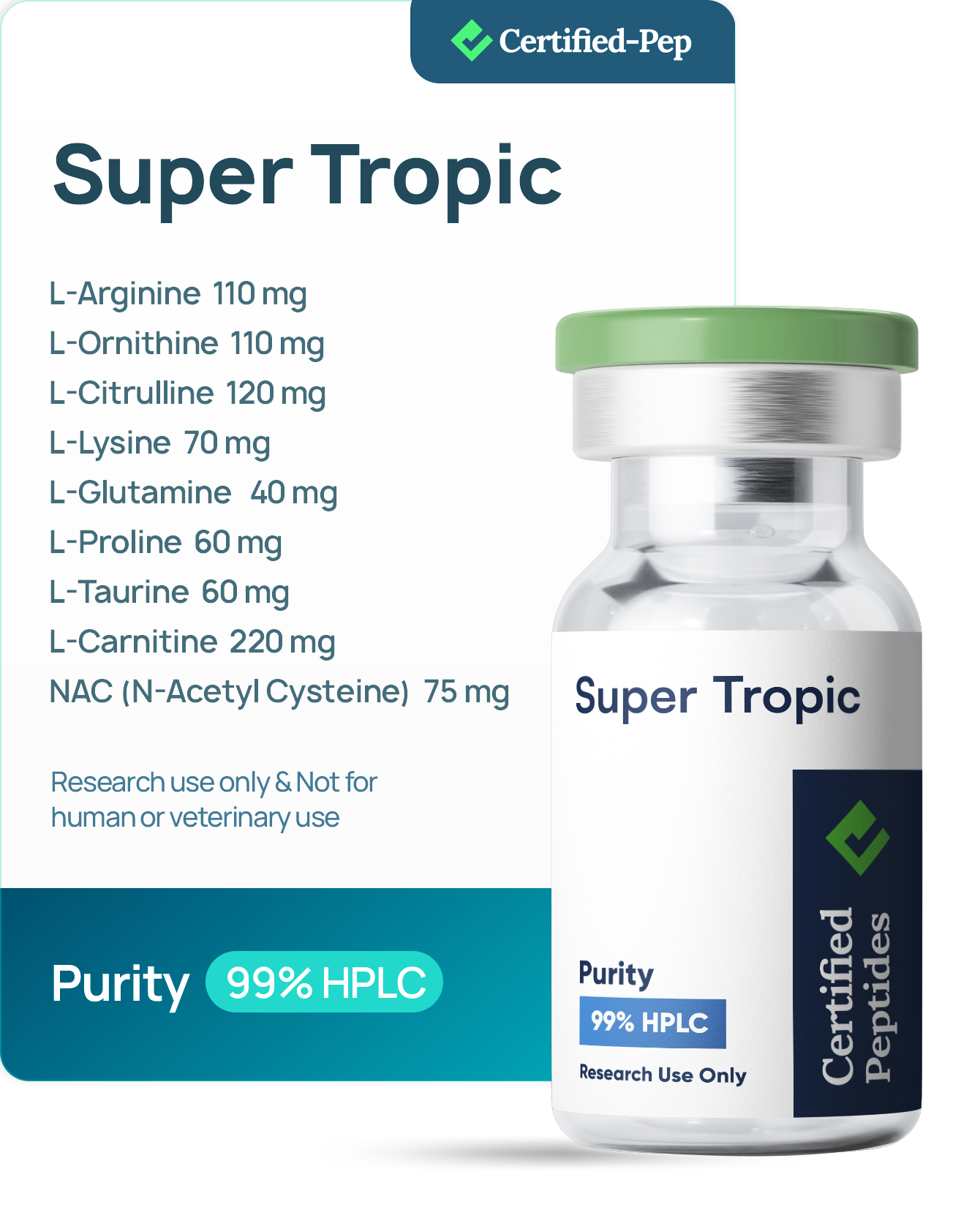
Super Tropic
- Ships same or next day Orders before 3PM EST, FedEx 2-Day Air
- Verify this lot Scan the QR code on your label
- Real U.S. support Live chat and email, 7 days a week
For research use only. Not for human or veterinary consumption.
Certified-Pep only sells U.S.-made peptides and products.
Key Features:
Made in the USA
Batch tested at a verifiable U.S. laboratory for identity, content and purity
Screened for endotoxins, heavy metals and sterility
Rigorous quality testing on every batch
For laboratory and research use only
- PURITY: 99%+
- CAS: N/A
- FORM: LIQUID SOLUTION
- PURITY: 99%+
| SUPER TROPIC | |
|---|---|
| SKU | CP_SSB_SUPER_TROPIC_10ML_VIAL |
| CATEGORY | Lipotropic Compounds |
| CAS | N/A |
| VIAL SIZE | 10 mL |
| FORM | LIQUID SOLUTION |
| MOLECULAR WEIGHT | N/A |
| COMPOSITION | N/A |
| MOLECULAR FORMULA | N/A |
| ITEM ID | 131440 |
Contents and Nonclinical Research
L-ARGININE
CAS#: 74-79-3
FORMULA: C6H14N4O2
174. 2 g/mol
Wound repair in rats: In diabetic rats with experimental wounds, L-arginine increased wound-breaking strength by approximately 44% and wound hydroxyproline content—a measure associated with collagen accumulation—by approximately 40% compared with saline-treated diabetic controls. [1]
L-ORNITHINE
CAS#: 70-26-8
FORMULA: C5H12N2O2
MOLECULAR WEIGHT: 132.16 g/mol
Stress response in mice: In mice exposed to restraint stress, orally administered L-ornithine significantly reduced circulating corticosterone at one of the tested doses compared with controls. Corticosterone is a hormone involved in the rodent stress response. [2]
L-CITRULLINE
CAS#: 372-75-8
FORMULA: C6H13N3O3
MOLECULAR WEIGHT: 175.19 g/mol
Muscle protein synthesis in rats: In aged, malnourished rats undergoing refeeding, a citrulline-enriched diet increased muscle protein synthesis and muscle protein content compared with a diet supplemented with other nonessential amino acids. [3]
L-LYSINE
CAS#: 56-87-1
FORMULA: C6H14N2O2
MOLECULAR WEIGHT: 146.19 g/mol
Arterial calcification in rats: In rats with adenine-induced kidney disease maintained on a low-protein diet, dietary L-lysine hydrochloride markedly reduced arterial mineral accumulation compared with unsupplemented and glycine-supplemented disease controls. This occurred without significant differences in serum creatinine or urea nitrogen among those groups. [4]
L-GLUTAMINE
CAS#: 56-85-9
FORMULA: C5H10N2O3
MOLECULAR WEIGHT: 146.14 g/mol
Intestinal inflammation in mice: In a mouse model of dextran sulfate sodium (DSS)-induced colitis, oral L-glutamine reduced colon tissue damage and inflammatory changes. Researchers also observed lower colonic levels of TNF-α and leukotriene B4, two inflammatory signaling molecules. [5]
L-PROLINE
CAS#: 147-85-3
FORMULA: C5H9NO2
MOLECULAR WEIGHT: 115.13 g/mol
Tissue protein synthesis in piglets: In neonatal Yucatan miniature piglets receiving intravenous nutrition, a proline-supplemented formulation produced higher protein-synthesis rates in muscle, skin, and small-intestinal tissue than a low-proline formulation. Nitrogen retention was also higher in the supplemented group. [6]
L-TAURINE
CAS#: 107-35-7
FORMULA: C2H7NO3S
MOLECULAR WEIGHT: 125.15 g/mol
Oxidative stress in mice: In an iron-overload mouse model, taurine supplementation reduced liver lipid peroxidation—a marker of oxidative damage—and increased antioxidant enzyme activity compared with iron-overloaded controls. Researchers also reported preservation of reduced glutathione levels. [7]
L-CARNITINE
CAS#: 541-15-1
FORMULA: C7H15NO3
MOLECULAR WEIGHT: 161.2 g/mol
Liver injury in rats: In rats subjected to interrupted liver blood flow followed by restoration of circulation, L-carnitine pretreatment reduced serum AST activity, a marker of tissue injury, compared with untreated injury controls. The findings supported a protective effect within this experimental liver-injury model. [8]
N-ACETYL CYSTEINE
CAS#: 616-91-1
FORMULA: C5H9NO3S
MOLECULAR WEIGHT: 163.19 g/mol
Liver injury in mice: In a mouse model of acetaminophen toxicity, NAC administered after acetaminophen exposure reduced liver injury, peroxynitrite-associated oxidative damage, and DNA fragmentation compared with acetaminophen alone. Protection was associated with recovery of mitochondrial glutathione and support of cellular energy metabolism. [9]
References
1.L-Arginine: Shi HP et al. (2003). Supplemental L-arginine enhances wound healing in diabetic rats. Wound Repair and Regeneration, 11(3), 198–203.
2.L-Ornithine: Kurata K et al. (2012). Orally administered L-ornithine reduces restraint stress-induced activation of the hypothalamic-pituitary-adrenal axis in mice. Neuroscience Letters, 506(2), 287–291.
3.L-Citrulline: Osowska S et al. (2006). Citrulline modulates muscle protein metabolism in old malnourished rats. American Journal of Physiology–Endocrinology and Metabolism, 291(3), E582–E586.
4.L-Lysine: Dietary L-lysine prevents arterial calcification in adenine-induced uremic rats (2014).
5.L-Glutamine: L-Glutamine attenuates DSS-induced colitis via induction of MAPK phosphatase-1 (2018). Nutrients, 10(3), 288.
6.L-Proline: Brunton JA et al. (2012). Proline supplementation to parenteral nutrition results in greater rates of protein synthesis in the muscle, skin, and small intestine in neonatal Yucatan miniature piglets. The Journal of Nutrition, 142(6), 1004–1008.
7. Taurine: Zhang Z et al. (2014). Taurine supplementation reduces oxidative stress and protects the liver in an iron-overload murine model. Molecular Medicine Reports, 10, 2255–2262.
8.L-Carnitine: The protective effect of L-carnitine on hepatic ischemia-reperfusion injury in rats.
9.N-Acetylcysteine: Saito C, Zwingmann C, and Jaeschke H. (2010). Novel mechanisms of protection against acetaminophen hepatotoxicity in mice by glutathione and N-acetylcysteine. Hepatology, 51(1), 246–254.
 Sale
 Sale
 Sale
 Sale