
 Sale
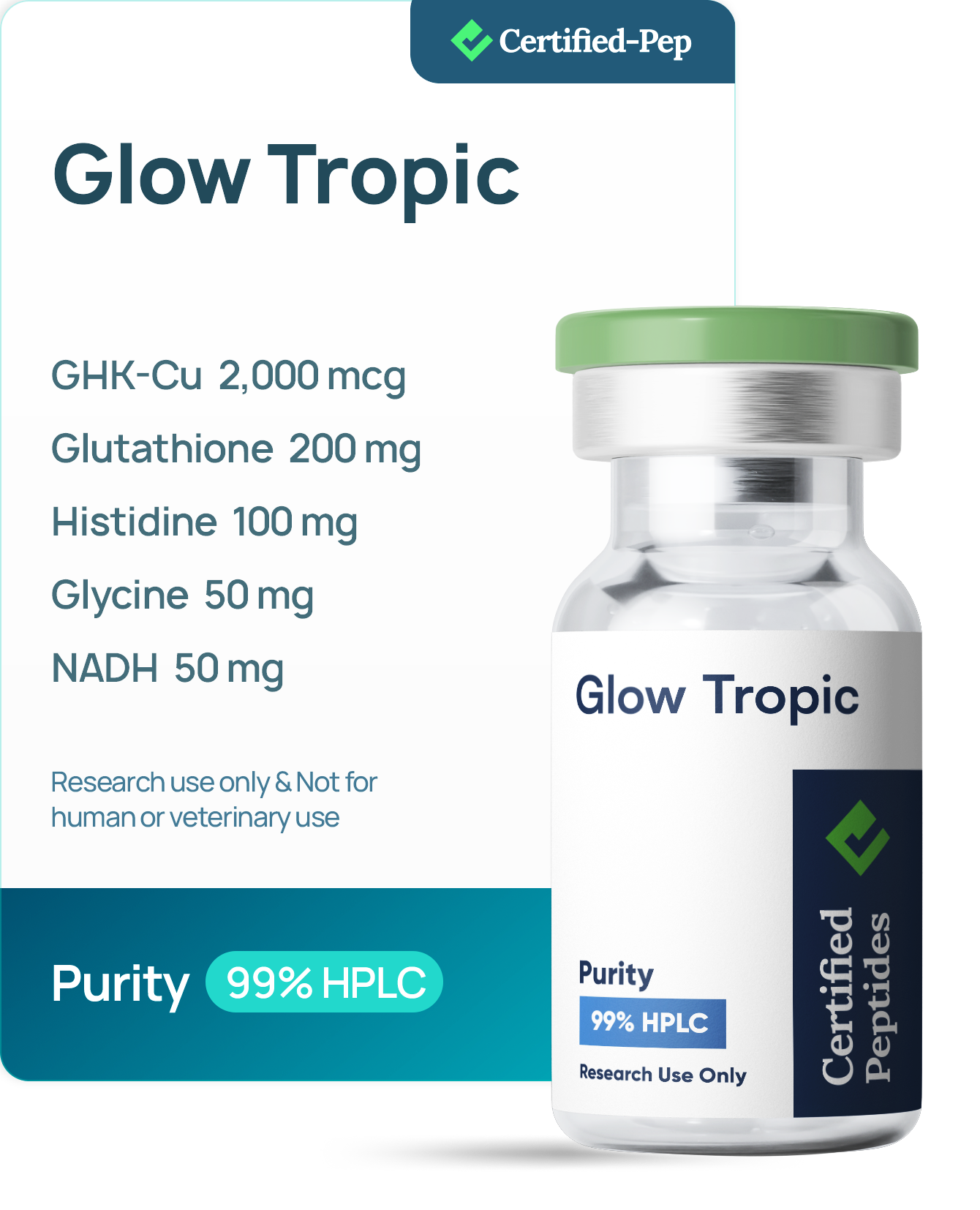
GLOW Tropic
- Ships same or next day Orders before 3PM EST, FedEx 2-Day Air
- Verify this lot Scan the QR code on your label
- Real U.S. support Live chat and email, 7 days a week
For research use only. Not for human or veterinary consumption.
Certified-Pep only sells U.S.-made peptides and products.
Key Features:
Made in the USA
Batch tested at a verifiable U.S. laboratory for identity, content and purity
Screened for endotoxins, heavy metals and sterility
Rigorous quality testing on every batch
For laboratory and research use only
- PURITY: 99%+
- CAS: N/A
- FORM: LIQUID SOLUTION
- PURITY: 99%+
| GLOW TROPIC | |
|---|---|
| SKU | CP_GGH_GLOW_TROPIC_10ML_VIAL |
| CATEGORY | Lipotropic Compounds |
| CAS | N/A |
| VIAL SIZE | 10 mL |
| FORM | LIQUID SOLUTION |
| MOLECULAR WEIGHT | N/A |
| COMPOSITION | N/A |
| MOLECULAR FORMULA | N/A |
| ITEM ID | 131441 |
Composition and Nonclinical Research Context
GHK-Cu
CAS#: 89030-95-5
FORMULA: C14H22CuN6O4
MOLECULAR WEIGHT: 401.91 g/mol
Connective-tissue formation in rats: Maquart et al. (1993) evaluated GHK-Cu in wound chambers implanted beneath the skin of rats. Compared with saline controls, GHK-Cu increased collagen and glycosaminoglycan accumulation in a concentration-dependent manner, indicating greater formation of the structural material surrounding cells. [1]
GLUTATHIONE
CAS#: 70-18-8
FORMULA: C10H17N3O6S
MOLECULAR WEIGHT: 307.32 g/mol
Liver injury in mice: Bajt et al. (2003) studied glutathione in a mouse model of acetaminophen-induced liver injury. Glutathione administered after acetaminophen exposure reduced liver-cell death and circulating ALT activity—a marker of liver injury—by approximately 62–66% at 24 hours compared with acetaminophen alone. [2]
HISTIDINE
CAS#: 71-00-1
FORMULA: C6H9N3O2
MOLECULAR WEIGHT: 155.15 g/mol
Intestinal inflammation in mice: Andou et al. (2009) investigated dietary histidine in a mouse model of experimentally induced colitis. Histidine reduced microscopic damage to colon tissue, colon weight, and expression of TNF-α, an inflammatory signaling molecule. These findings demonstrated an anti-inflammatory effect within this experimental model. [3]
GLYCINE
CAS#: 56-40-6
FORMULA: C2H5NO2
MOLECULAR WEIGHT: 75.07 g/mol
Cell protection in isolated rat livers: Zhong et al. (1996) examined isolated rat livers exposed to reduced blood flow followed by restoration of flow. Glycine reduced liver-cell injury in a concentration-dependent manner. Under the tested conditions, cell death in previously oxygen-deprived regions decreased from approximately 30% to less than 10%. [4]
NADH
CAS#: 606-68-8
FORMULA: C21H27N7O14P2Na2
MOLECULAR WEIGHT: 709.4 g/mol
Spatial learning in aged rats: Rex et al. (2004) evaluated NADH in aged Wistar rats using the Morris water maze, a test of spatial learning and memory. Repeated NADH administration improved performance during learning and the subsequent spatial-memory test compared with vehicle controls. Motor coordination was unaffected in a separate test. [5]
References
1.GHK-Cu: Maquart FX et al. (1993). In vivo stimulation of connective tissue accumulation by the tripeptide-copper complex glycyl-L-histidyl-L-lysine-Cu2+ in rat experimental wounds. Journal of Clinical Investigation, 92(5), 2368–2376.
2.Glutathione: Bajt ML et al. (2003). Scavenging peroxynitrite with glutathione promotes regeneration and enhances survival during acetaminophen-induced liver injury in mice. Journal of Pharmacology and Experimental Therapeutics, 307(1), 67–73.
3.Histidine: Andou A et al. (2009). Dietary histidine ameliorates murine colitis by inhibition of proinflammatory cytokine production from macrophages. Gastroenterology, 136(2), 564–574.e2.
4.Glycine: Zhong Z, Jones S, and Thurman RG. (1996). Glycine minimizes reperfusion injury in a low-flow, reflow liver perfusion model in the rat. American Journal of Physiology, 270(2 Pt 1), G332–G338.
5.NADH: Rex A, Spychalla M, and Fink H. (2004). Treatment with reduced nicotinamide adenine dinucleotide (NADH) improves water maze performance in old Wistar rats. Behavioural Brain Research, 154(1), 149–153.
 Sale
 Sale
 Sale
 Sale