
 Sale
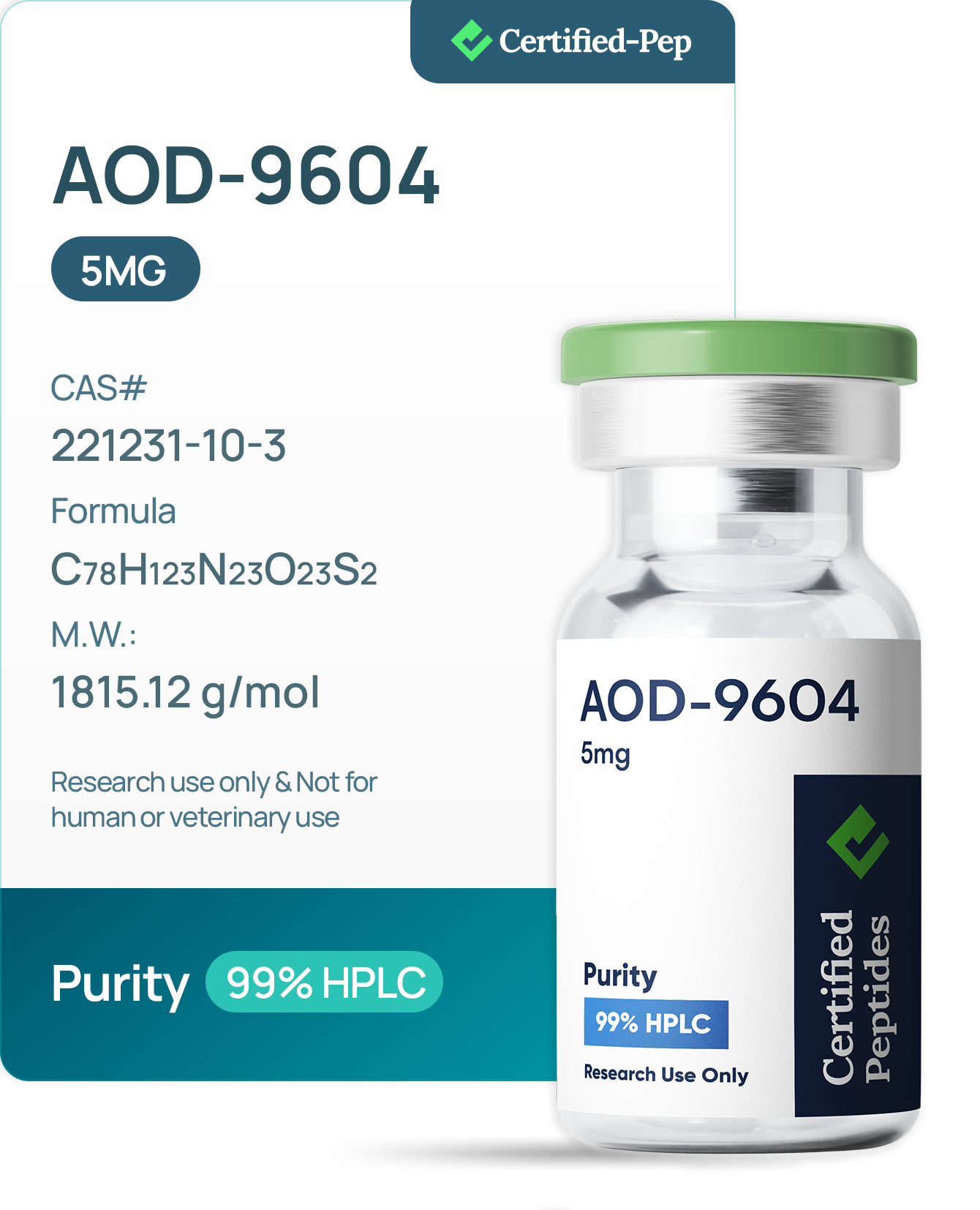
AOD 9604
5mg
- Ships same or next day Orders before 3PM EST, FedEx 2-Day Air
- Verify this lot View the lab reports · View the Vanguard certificate
- Real U.S. support Live chat and email, 7 days a week
For research use only. Not for human or veterinary consumption.
- PURITY: 99%+
- CAS: 386264-39-7
- FORM: LYOPHILIZED POWDER
- DOSAGE: 5 MG
- PURITY: 99%+
| AOD 9604 5MG | |
|---|---|
| SKU | CP_AOD_9604_3ML_VIAL |
| CATEGORY | Lyophilized Peptide |
| CAS | 386264-39-7 |
| VIAL SIZE | 3 mL |
| FORM | LYOPHILIZED POWDER |
| MOLECULAR WEIGHT | 1815.1 g/mol |
| SEQUENCE | Tyr-Leu-Arg-Ile-Val-Gln-Cys-Arg-Ser-Val-Glu-Gly-Ser-Cys-Gly-Phe; Cys7-Cys14 disulfide |
| MOLECULAR FORMULA | C78H123N23O23S2 |
| ITEM ID | 72 |
AOD 9604 5MG provides AOD-9604 as lyophilized powder in a 3 mL vial.
Research Context
AOD-9604 has appeared in the analytical chemistry literature primarily in the context of developing detection methods for low-molecular-mass peptides in biological matrices.
Analytical Detection in Biological Matrices
Thomas et al. (2016) described a liquid chromatography-ion mobility time-of-flight mass spectrometry method for the direct detection of AOD-9604 and other peptides below 2 kDa in urine. The assay was validated for specificity and sensitivity across the target analyte panel [Thomas et al., 2016].
Chromatographic-Mass Spectrometric Approaches
Thevis et al. (2014) reviewed chromatographic-mass spectrometric, electrophoretic, and immunological strategies developed for detecting peptidic compounds including AOD-9604 at low concentration levels in biological specimens [Thevis et al., 2014].
AOD 9604: a peptide fragment of human growth hormone
AOD 9604 is a synthetic peptide fragment, 16 amino acids long, copied from the tail end of the human growth hormone molecule (residues 177 to 191) with a tyrosine added at the front. Frank Ng's group at Monash University originally developed it in the 1990s, and Metabolic Pharmaceuticals in Melbourne tried to turn it into an anti obesity drug. The bet was that this short stretch carried the metabolic effects of growth hormone on fat without the growth promoting ones. Its molecular formula is C78H123N23O23S2, and the 5 mg vial is made by solid phase peptide synthesis for laboratory research.
How the fragment differs from growth hormone and growth hormone secretagogues
The full hgh molecule has 191 amino acids. It binds the growth hormone receptor, raises IGF-1, pushes blood glucose up and can worsen insulin resistance. AOD 9604 is far too small to switch that receptor on, and in cell and animal work it left IGF-1 and growth hormone levels alone. It isn't one of the growth hormone secretagogues either, since it never touches the pituitary gland.
Fat breakdown, lipolysis and adipose tissue in animal studies
In rodent adipose tissue, Ng et al. reported that the fragment stimulates lipolysis and cuts fat storage [1]. Heffernan's team then gave it to obese mice for weeks. Chronic treatment lowered body weight and fat, with more fat oxidation and fat mobilization [2]. They also ran it in mice lacking β3 adrenergic receptors to see what the effect depended on.
The working model pairs fat breakdown with inhibiting lipogenesis, so fat cells release more and store less. Appetite and gastric emptying weren't the targets.
Clinical trials, medical weight loss claims and the placebo group
Human testing ran through the 2000s. Stier et al. later pooled safety data from six clinical trials, all randomized double blind placebo controlled trials covering single doses and longer courses [3]. Efficacy was a different story. A larger 24-week trial in 2007 didn't clearly beat the placebo group on weight loss, and the program to treat obesity was shut down. What the human data support is tolerability. They don't back claims of medical weight loss, abdominal fat reduction or body composition optimization.
Safety data and adverse effects: subcutaneous injection and injection site reactions
Stier et al. described a tolerability profile indistinguishable from placebo across those six double blind trials [3]. No serious adverse events were deemed possibly related to AOD 9604, and nobody tested made antibodies against it. Glucose tolerance tests are where it parted ways with full growth hormone: there was no impaired glucose tolerance or glucose intolerance, and no negative effects on glucose metabolism. Insulin sensitivity and blood sugar held steady over the active treatment period, with no clinically relevant change. The summary says less about blood pressure. Of the adverse effects reported in studies using subcutaneous injection, headache and mild reactions at the injection site were the most common.
Metabolic health, peptide therapy and other peptides
Online, it's sold as peptide therapy for fat loss, weight management and metabolic health, usually stacked with other peptides or other therapies. Some sellers pair it with resistance training and say it will preserve lean mass or muscle mass. It doesn't stimulate protein synthesis, and the trials never measured lean mass, so nothing backs that up. Nobody has studied it against cardiovascular disease or abdominal adiposity either. None of this is meant to constitute medical advice, and a person's health history or goals don't change its research-only status.
FDA approval and the regulatory picture
The regulatory picture is short. AOD 9604 has no FDA approval for any use. When sellers call it "FDA approved," they're usually mixing up a separate food-ingredient (GRAS) status with approval as a medicine. The World Anti-Doping Agency bans it in sport, and this page gives no dose, timing or protocol for people.
Quality testing and storage
Certified Peptides makes its peptides in a cGMP facility in Texas. Each batch goes to an ISO/IEC 17025 accredited US lab for purity (HPLC), quantity, identity (LC-MS), endotoxins, heavy metals and sterility testing. When you order AOD 9604, match the QR code on the vial to its report in the COA Library. Lab Testing covers the full panel. Keep vials sealed, cold and out of the light.
For related metabolic work, see MOTS-c, 5-Amino-1MQ and Tesamorelin, a GHRH analog studied for visceral fat.
Questions researchers ask
Why was a tyrosine added to the hGH fragment?
The extra tyrosine helped stabilize the fragment and made it easy to label in early studies. Everything after it matches hGH residues 177 to 191, including two cysteines whose disulfide bond holds a small loop tied to the fat-related activity.
How do researchers measure lipolysis in AOD 9604 studies?
In isolated fat cells or fat tissue, the standard readouts are glycerol and free fatty acid release. Whole-animal work adds body weight, fat pad weight and the respiratory exchange ratio, which tracks fat oxidation. Measuring IGF-1 at the same time shows the fragment isn't behaving like full growth hormone.
Why did the drug program stop?
The safety record was clean, but the big trial couldn't beat placebo on weight. Without efficacy there was no route to approval, which is why AOD 9604 now turns up as a fat metabolism research tool instead of a drug candidate.
How does AOD 9604 differ from tesamorelin?
Tesamorelin is a GHRH analog: it makes the pituitary release full growth hormone, and IGF-1 rises after that. AOD 9604 skips the pituitary and leaves IGF-1 flat, so the two answer different questions about growth hormone and fat.
What controls should AOD 9604 studies include?
A vehicle arm, a full growth hormone arm, and IGF-1 and glucose measures make the results far easier to read. Diet and housing temperature shift fat metabolism in rodents, so both belong in the methods.
Disclaimer
For laboratory research use only. Not for human or veterinary use. Not for consumption. This product is not a drug, food or cosmetic. Information on this page is for educational purposes, has not been evaluated by the FDA, and is not intended to diagnose, treat, cure or prevent any disease.
References
- Ng FM et al. "Metabolic studies of a synthetic lipolytic domain (AOD9604) of human growth hormone." Horm Res. 2000;53(6):274-278. PubMed
- Heffernan MA et al. "The effects of human GH and its lipolytic fragment (AOD9604) on lipid metabolism following chronic treatment in obese mice and beta(3)-AR knock-out mice." Endocrinology. 2001;142(12):5182-5189. PubMed
- Stier H, Vos E, Kenley D. "Safety and Tolerability of the Hexadecapeptide AOD9604 in Humans." J Endocrinol Metab. 2013;3(1-2):7-15. J Endocrinol Metab
 New
 New
 Sale
 New