Cerebrolysin Benefits: What Trials in Stroke, Brain Injury and Dementia Show
Cerebrolysin benefits are a mixed story. The preparation has more clinical trials behind it than almost any neuropeptide product, yet the best reviews still call the evidence weak. Some trials report better recovery after stroke or brain injury. Pooled analyses often find little or no change in the outcomes that matter most.
This article covers what the studies measured, what the reviews concluded and where the claims go further than the data. It is written for laboratory research context only. Cerebrolysin is not approved by the U.S. Food and Drug Administration, the research-grade material sold by Certified-PEP is not for human use, and nothing below is medical advice. For quick answers on related compounds, see our peptide FAQ.
Cerebrolysin Benefits at a Glance
- Cerebrolysin is a mixture, not a single peptide. It contains low molecular weight peptide fragments and free amino acids made from purified porcine brain tissue.
- In acute ischemic stroke, a 2023 Cochrane review of seven trials found probably little to no difference in death, and more non-fatal serious adverse events with treatment.
- Trials after traumatic brain injury and in Alzheimer’s disease report modest gains on some scales. Studies are small, short and often funded by the maker.
- Evidence that Cerebrolysin improves cognitive function in healthy adults is limited. Marketing claims about brain fog go beyond any published trial.
- It is sold as a drug in many countries, but not in the United States.
What Is Cerebrolysin?
Cerebrolysin is a multimodal neuropeptide preparation. It is made by breaking down purified porcine brain proteins with enzymes. The result is a clear liquid that holds a large set of low molecular weight peptide fragments, mostly below 10 kDa, together with free amino acids. Ever Pharma in Austria has made it for decades. The injectable’s product information also lists sodium hydroxide as a pH adjuster, which shows that it is a formulated drug and not a pure peptide.
Because the fragments are small, part of the mixture is thought to cross the blood brain barrier. No single fragment explains its action, so researchers call it multimodal. That also makes it hard to study. A mixture cannot be summed up by one purity number, and batches can differ. Our guide to peptide purity explains why that matters.
How Cerebrolysin Works in Preclinical Research
Most mechanism data come from cell cultures and rodents. The mixture behaves like the neurotrophic factors the brain makes for itself, and papers often compare it to brain derived neurotrophic factor (BDNF) and nerve growth factor.
Reported findings in animals include:
- Higher BDNF signaling and better neuronal survival.
- Less glutamate excitotoxicity and less uncontrolled apoptosis in neuronal cells.
- Axonal sprouting, new synaptic connections and higher synaptic density in the hippocampus, a brain region tied to memory.
- Changes in synaptic regulation and neural transmission.
- Lower pro inflammatory cytokines after injury, and effects on the neurovascular unit.
- Less buildup of toxic protein aggregates in some Alzheimer’s disease models.
One line of work points to the sonic hedgehog signaling pathway. In rodent stroke models, Cerebrolysin improved neurological function alongside higher activity of the shh pathway, and blocking the pathway reduced the effect.[1] Other reports describe activation of the CREB and PGC-1 alpha pathway, effects on neurogenesis in the hippocampus and better blood brain barrier integrity. These are animal and cell findings. They raise questions and do not settle them.
Preclinical Studies Versus Clinical Studies
Preclinical studies use cells and animals. They show what a mixture can do in a dish or a rodent, and they guide later work. They do not show what happens in people. Animal studies of stroke often start treatment minutes after the injury, in young and healthy animals. Real patients are older, have other illnesses and arrive hours later. That gap is one reason many neuroprotective drugs that worked in rodents failed in human trials.
Two kinds of effect show up in the animal work. Some papers describe protection of brain cells from injury, such as less cell death after low oxygen. Others describe repair, such as new connections between neurons. Both are plausible reasons to test the mixture in brain pathology models. Neither one, alone, predicts a gain in daily life. For readers building a study, the point is to match the model to the question and to state which outcome was the main one before the work starts.
Effect of Cerebrolysin in Acute Ischemic Stroke
Stroke is where most trials sit, and where the effect of Cerebrolysin looks least impressive once the data are pooled. An ischemic stroke blocks blood flow to part of the brain. Researchers test whether an add-on to standard care can speed recovery.
What the trials found
The CASTA trial enrolled 1,070 people with acute ischemic stroke in Asia and gave Cerebrolysin or saline for 10 days alongside standard care. Its main outcome, a combined score of three scales at 90 days, showed no clear difference.[2] A later look at severe cases found lower 90-day mortality, but that analysis was done after the fact and needs a new trial to confirm.
The CARS trial gave treatment with early motor rehabilitation starting one to three days after stroke. Arm function improved at 90 days, and the authors called the result exploratory.[3] In ischemic stroke patients, other small trials reported better scores on the NIH Stroke Scale, and some were run or supported by the manufacturer.
What the pooled reviews concluded
A 2017 meta-analysis of seven randomized trials with 1,779 patients with acute ischemic stroke found no clear effect on death, disability or adverse events, and the authors said routine use could not be backed by the evidence.[4]
The 2023 Cochrane review pooled seven trials with 1,773 participants.[5] It found probably little to no difference in death, with a risk ratio of 0.96, and it found more non-fatal serious adverse events in treated groups, with a risk ratio of 2.39. It could not judge functional outcomes well because the included studies did not report them in a usable way. Cochrane graded the evidence low or very low.
The balance matters here. A trial that shows better scores on a motor scale is real data. A review that finds no change in death or disability, plus a possible rise in serious events, is also real data. Both can be true, and neither shows that Cerebrolysin improves recovery in a way a clinician could count on.
What guidelines say
The 2021 guideline on neurorehabilitation after stroke from the European Academy of Neurology and European Federation of NeuroRehabilitation Societies is cited by the manufacturer as supporting Cerebrolysin as an add-on therapy in moderate to severe stroke, started early.[6] That page is marketing material, so check the original wording and evidence grade before relying on it. Other bodies have not given broad backing. A neurorehabilitation societies guideline is one source, not a verdict, and it sits next to the Cochrane result above.
Hemorrhagic stroke
Evidence in hemorrhagic stroke is thinner still. Most trials enrolled ischemic cases. Claims about bleeding strokes rest on small studies and do not carry the same support.
Some papers state that treatment helped by preventing death in severe stroke. The data do not back that as a general claim. The Cochrane authors found no clear change in deaths, and the severe-stroke result from CASTA came from a subgroup analysis. A clinical application in that group would need a new, planned trial. For now, the relevant information is simple: the signal is interesting, and it is unconfirmed. Clinical use in countries where the drug is sold rests on local approval and on pharmacological support from small trials, not on a proven survival benefit.
Cerebrolysin Administered After Traumatic Brain Injury
Traumatic brain injury (TBI) is a leading cause of disability. Global burden estimates count about 27 million new cases a year.[7] Survivors often face lasting problems with thinking, mood and movement, which is why researchers study add-on therapy.
The CAPTAIN trials tested Cerebrolysin administered after moderate to severe TBI. CAPTAIN I enrolled 46 patients, and CAPTAIN II enrolled about 139 analyzed patients.[8] A prospective meta-analysis of both trials covered 185 patients and reported small to medium effects on recovery scales at 30 and 90 days.[9] Cerebrolysin may improve motor skills and cognitive symptoms in some scales, according to those reports.
The limits are plain. The trials were small, and the main outcome in CAPTAIN I narrowly missed its target. Follow-up was short, and the studies were not powered to measure mortality. Claims that Cerebrolysin reduces anxiety or helps every patient have not been shown in large, independent trials. It is marketed for TBI rehabilitation in many countries, and the manufacturer says it is used in more than 45. Use in a country does not equal proof of benefit.
How Cerebrolysin Trials Were Designed
Most trials use a similar frame. Researchers recruit patients treated within a set window after the event, add Cerebrolysin or saline to standard care and follow them for weeks or months. The treatment period is usually short, often one to four weeks. Some trials repeat treatment courses, and the number of courses differs by study. This article does not describe amounts or schedules, because those belong to the trial protocols and to physicians, not to a research guide.
Outcome choice shapes the story. Scales that track motor function, such as arm movement tests, can show a small beneficial effect while death and disability scores do not move. Reports of functional recovery depend on which scale the authors picked and when they measured it. Neurological outcomes at 30 days can differ from those at 90 days. A fair reading asks which outcome was planned first, how many patients dropped out and who paid for the study.
Researchers also check how well a trial was blinded. If staff can tell which patients received an injectable mixture, bias can creep into scale scores. That is another reason pooled reviews rate many of these trials as low certainty.
Terms used in the literature
British spelling appears in Cochrane titles, so you will see acute ischaemic stroke in searches and acute ischemic stroke in American papers. Both mean the same condition. Likewise, the European Journal of Neurology carried several of the dementia reports, and the guideline groups named above publish in the same journal family.
Alzheimer’s Disease, Dementia Patients and Cognitive Impairment
Dementia is a broad term. Alzheimer’s disease dementia and vascular dementia have different causes, and trial results differ too.
A 24-week double blind trial in mild to moderate Alzheimer’s disease tested three dose levels. It reported better scores on cognitive and global scales for treated groups.[10] Another trial of Cerebrolysin plus donepezil in 197 people found no clear between-group difference in cognition, function or behavior, though global ratings favored treatment. In patients with mild cognitive impairment, some small trials report improved cognitive performance against a control group.
For vascular dementia, the 2019 Cochrane review pooled six trials with 597 people.[11] Three studies found a small benefit on cognitive measures, with a standardized mean difference of 0.36. Two studies found more people improved on global ratings. Adverse events did not differ clearly. Cochrane rated the certainty of the evidence as very low, and the authors said the benefit may be too small to matter in daily life.
So what do dementia patients gain? Possibly a small improvement on a test score. That is a different claim from slowing the disease, and no trial has shown that.
Cognitive Function in Healthy Adults
Online sellers pitch Cerebrolysin to healthy adults for memory, focus and mental clarity. The published trials enrolled people with a diagnosed injury or disease. They did not test healthy adults, and none measured brain fog as an outcome.
Limited evidence exists for effects on cognitive function in healthy people. Reports from users who say they feel sharper during treatment cycles are anecdotes. They cannot separate the drug from expectation, sleep or other changes. Even in older adults with mild impairment, effects were small. The claim that it can sharpen thinking in someone without a condition has no trial behind it.
Adverse Effects and Safety
Cerebrolysin treatment is usually described as well tolerated in short trials, but that phrase hides detail worth reading.
The safety record is mixed in a way worth stating plainly. Short trials describe adverse effects as mostly mild and short-lived. Common ones include headache, nausea, dizziness and mild fever or local irritation at the injection site. Some people report allergic reactions, and seizures are possible in severe cases.
Product information lists active epilepsy and severe renal impairment among the contraindications, and it advises caution with other medications. We did not find a central marketing authorization from the European Medicines Agency, and national status varies. Some summaries call it a safe category of drug because of its long use, but the Cochrane stroke review found more non-fatal serious adverse events with treatment, with a larger signal at higher doses. Because Cerebrolysin is made from animal tissue, batch control also matters.
Where it is used as a drug, it is given by infusion or injection under medical supervision in countries that approve it. That setting is not a research bench. Nothing here is a protocol, and no dose is offered.
What the Research Does Not Show
The honest summary of Cerebrolysin benefits is that they remain unproven where it counts most. The list below sets out the gaps.
- No clear proof of better survival after ischemic stroke. Pooled analyses show little or no difference in death.
- No large independent trial confirming a gain in daily function after stroke or TBI.
- No evidence of benefit for healthy adults seeking cognitive enhancement.
- No single active fragment. The mixture cannot be reduced to one compound.
- No FDA approval. The agency has not authorized it for any condition.
- A possible rise in non-fatal serious adverse events in stroke trials.
Better evidence would mean larger, blinded trials run by groups with no commercial stake. They would report real-life function, not only scale scores, and they would register outcomes in advance. The Cochrane stroke authors made that call too.
Sourcing Cerebrolysin for Laboratory Research
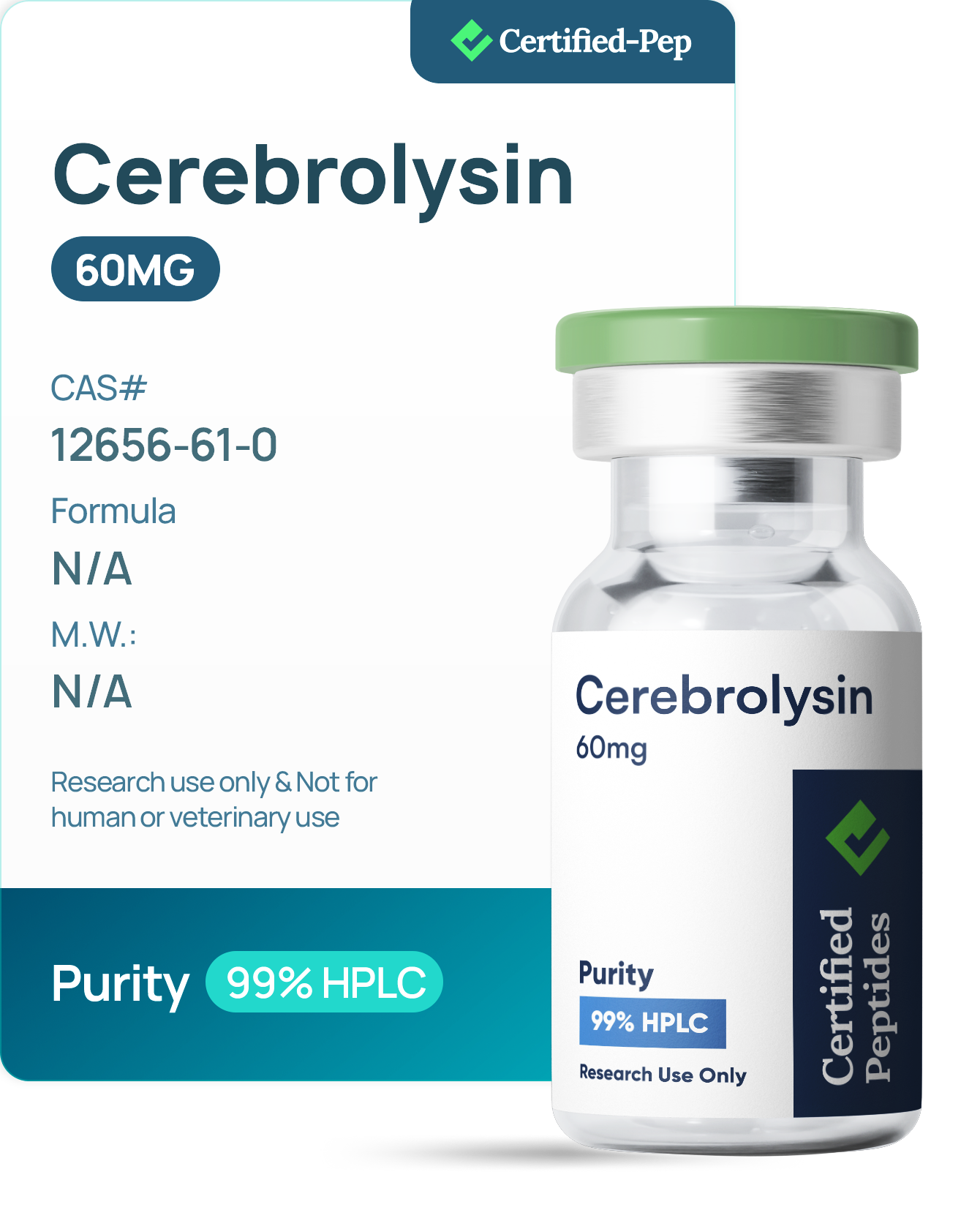
Certified-PEP offers Cerebrolysin 60mg for laboratory research use. It is made in the USA. An ISO/IEC 17025 third-party laboratory tests each lot for identity, endotoxins, heavy metals and sterility, and every lot ships with a COA. Read the research purposes only policy before you order.
Research Cerebrolysin
Cerebrolysin Benefits FAQ
What is Cerebrolysin used for?
In countries where it is approved, it is used after stroke and brain injury and in dementia. It is not FDA approved.
Does Cerebrolysin help stroke recovery?
Some trials report better arm function or neurological scores. The pooled Cochrane review found probably little or no difference in death, and more non-fatal serious events.
Is Cerebrolysin a peptide?
It is a mixture of peptide fragments and free amino acids from porcine brain. It is not one defined peptide.
What are the common side effects?
Headache, nausea, dizziness and mild fever are reported. Contraindications include active epilepsy and severe renal impairment.
Where can I see batch testing?
Batch reports are in the COA library, and the lab testing page lists the panel.
References
1. Zhang L et al. “Sonic hedgehog signaling pathway mediates cerebrolysin-improved neurological function after stroke.” Stroke. 2013;44(7):1965-1972. PubMed
2. Heiss WD et al. “Cerebrolysin in patients with acute ischemic stroke in Asia: results of a double-blind, placebo-controlled randomized trial (CASTA).” Stroke. 2012;43(3):630-636. PubMed
3. Muresanu DF et al. “Cerebrolysin and Recovery After Stroke (CARS): A Randomized, Placebo-Controlled, Double-Blind, Multicenter Trial.” Stroke. 2016;47(1):151-159. PubMed
4. Zhang D et al. “Efficacy and Safety of Cerebrolysin for Acute Ischemic Stroke: A Meta-Analysis of Randomized Controlled Trials.” Biomed Res Int. 2017;2017:4191670. PubMed Central
5. Ziganshina LE et al. “Cerebrolysin for acute ischaemic stroke.” Cochrane Database Syst Rev. 2023;10:CD007026. doi:10.1002/14651858.CD007026.pub7
6. European Academy of Neurology and European Federation of NeuroRehabilitation Societies. Guideline on neurorehabilitation after stroke. Eur J Neurol. 2021. doi:10.1111/ene.14936
7. GBD 2016 Traumatic Brain Injury and Spinal Cord Injury Collaborators. “Global, regional, and national burden of traumatic brain injury and spinal cord injury, 1990-2016.” Lancet Neurol. 2019;18(1):56-87. PubMed
8. Muresanu DF et al. “Effects of Cerebrolysin on functional outcome in patients with moderate-to-severe TBI: CAPTAIN II.” Neurol Sci. 2020;41(5):1171-1181. PubMed
9. Vester JC et al. “Cerebrolysin after moderate to severe traumatic brain injury: prospective meta-analysis of the CAPTAIN trials.” Neurol Sci. 2021;42(11):4531-4541. PubMed
10. Alvarez XA et al. “A 24-week, double-blind, placebo-controlled study of three dosage levels of Cerebrolysin in patients with mild to moderate Alzheimer’s disease.” Eur J Neurol. 2006;13(1):43-54. PubMed
11. Cui S et al. “Cerebrolysin for vascular dementia.” Cochrane Database Syst Rev. 2019;(11):CD008900. Cochrane
Research use only
Certified-PEP products are sold for laboratory research only. They are not drugs, foods, cosmetics or dietary supplements, and they are not for human or veterinary use. Nothing in this article describes effects in people or offers guidance for use in people.