
Benefits of Epithalon: What Research Shows About Telomerase, Melatonin and Cellular Aging
The benefits of epithalon are discussed online as if they were settled. They are not. Epithalon, also spelled epitalon, is a short synthetic peptide that a Russian research group built in the 1980s and 1990s. It has a small body of papers behind it, most from one institute in St. Petersburg, and nearly all of it comes from cell cultures, flies, mice and rats.
This article covers what those studies reported, how far the evidence goes and where the claims run ahead of it. It is written for laboratory research context only. Epithalon is not approved by the U.S. Food and Drug Administration for any medical use, and nothing below is advice for people.
Benefits of Epithalon at a Glance
- Epithalon is a synthetic tetrapeptide of four amino acids (Ala-Glu-Asp-Gly), modeled on epithalamin, an extract of the pineal gland.
- In cell studies, epitalon induced telomerase activity and lengthened telomeres in human fibroblasts. An independent 2025 study also saw telomere extension in cancer cell lines.
- In mice, repeated courses did not change average lifespan. Gains appeared only in the longest-lived animals.
- Reports of better melatonin rhythm and sleep come from small studies of pineal peptides, not from large blinded trials.
- Human evidence is limited, and long-term effects of raising telomerase are uncertain.
What Is Epithalon? The Epitalon Peptide Explained
Epithalon is a synthetic peptide made of four amino acids: alanine, glutamic acid, aspartic acid and glycine. Chemists write the tetrapeptide Ala-Glu-Asp-Gly, and say that the peptide epitalon is the four-residue unit. The molecular weight is about 390 daltons, which makes it far smaller than most research peptides.
It was designed from epithalamin, a natural extract of the pineal gland, a small gland in the brain that makes melatonin. Khavinson’s group analyzed that extract, picked out a short sequence and built a copy in the lab. The idea was that a four-residue peptide could reproduce some of the extract’s activity in a form that is easier to standardize. That is why you will see the compound described as a pineal gland peptide.
Two spellings circulate. Epitalon is common in papers, and epithalon is common on vendor pages. They name the same molecule. Our guide to peptide purity explains why a COA matters for a small peptide like this one.
Telomeres, Telomerase and the Molecular Mechanism
Most of the interest in epitalon comes from one idea. Telomeres are protective caps of repeated DNA sequences at the ends of chromosomes. Each time a cell divides, they shorten a little. When they get too short, the cell stops dividing. Telomerase is the enzyme that can add repeats back. Most adult cells make very little of it.
The molecular mechanism claimed for epitalon is that it switches on parts of the telomerase machinery. In a 2003 report, epitalon induced telomerase activity and telomere elongation in human fetal fibroblasts grown in culture.[1] A follow-up in 2004 found that treated cells passed the usual division limit. Control cells stopped near passage 34, and the epitalon group kept dividing past passage 44.[2] The authors linked this to the telomerase enzyme components, such as the catalytic subunit hTERT, being expressed in cells that normally lack them.
That is molecular evidence of a sort, but it has limits. The work used human somatic cells from one lab, in a dish. It does not show that epitalon maintains telomere length in a human organism. It also leaves open what the peptide binds to. Short peptides have been proposed to influence telomerase activity by interacting with DNA sequences and changing gene expression, and one review from the same group describes that idea.[8] Independent replication of the exact mechanism is thin.
The cancer question
Telomerase is also switched on in most cancers. That is why raising it is a worry as well as a hope. A 2025 independent study found that epitalon extended telomeres in normal epithelial cells and fibroblasts, and also in breast cancer cell lines, partly through an alternative lengthening pathway.[7] So the peptide may stimulate telomerase activity in cells where nobody wants it. Epitalon is not a cancer treatment, and no study shows it works as one. Healthy cell division and unchecked division can both depend on the same enzyme, which is why long-term effects remain uncertain.
Epitalon May Affect Cellular Aging Pathways
Cellular aging is a broad term. It covers telomere shortening, DNA damage, changes in gene expression and a drop in how well cells divide. Researchers use epitalon as a tool to ask whether short peptides can shift those cellular aging pathways.
Reported findings include:
- Longer telomeres in cultured human cells after treatment, as covered above.
- Altered gene expression in some tissues, according to the group’s reviews.
- Changes in the cell cycle in treated cultures.
- Fewer chromosomal aberrations in the bone marrow cells of treated mice.
Biological age is a loose term in this field, and no validated clock was used in the early papers. Claims that epitalon lowers biological age go beyond what was measured. What the studies show is narrower: a change in telomerase activity in cells, and some changes in markers in animals.
Lifespan Studies in Animals
The best-known animal result comes from a mouse study by Anisimov and colleagues. Female SHR mice, 54 per group, received monthly courses of epitalon by subcutaneous injection for their lives.[3] Mean lifespan did not change, at about 455 days in both groups. The difference showed up at the tail. The last 10% of survivors lived longer, 803 days against 709 days, a gain of about 13.3%. Maximum lifespan was 830 days against 739 days.
So the claim that epitalon increases lifespan by 13.3% in mice needs a correction. That figure describes the longest-lived tenth of the animals, not the average mouse. Mean lifespan did not move.
The same study looked at other markers:
- Total tumors were 32% in the treated group against 36% in controls, which was not a meaningful difference.
- Leukemia cases fell from six to one.
- Spontaneous tumor incidence overall was not clearly lower.
- Epitalon decreased chromosomal aberrations in bone marrow cells, 6.8% against 8.2% in the 12-month controls, or about 17% lower.
Related work from the same group reported fewer mammary tumors in a cancer-prone mouse strain, and an increase in lifespan of 11% to 16% in fruit flies. We did not verify the details of those papers, and a single group produced most of them. Most animal work compares young mice with aged ones, so age-matched controls matter. Route also varies. Some papers used subcutaneous injection, and others used intraperitoneally administered epitalon, which makes comparison harder.
Melatonin Regulation and Circadian Rhythm Support
Melatonin is the hormone the pineal gland releases at night. Its level falls with age, and that fall is linked to weaker sleep wake cycles. Because epitalon traces back to a pineal extract, researchers asked whether it supports melatonin production in old animals and old people.
A 2007 report from Kyiv looked at the daily melatonin rhythm in old monkeys and in elderly people.[4] Pineal peptides, including epitalon and the extract epithalamin, brought the melatonin curve closer to a younger pattern. Melatonin secretion at night rose in treated groups. Those were small groups, and the paper tested a set of pineal peptides rather than epitalon alone.
A related line of work reported that pineal peptides restored some age-related shifts in hormonal function of the pineal gland and the pancreas. We read only the abstract, so treat that as a lead. Claims that epitalon “improves glucose tolerance and insulin regulation” come from experimental models and are not human findings.
What can be said fairly is this. Epitalon may influence melatonin synthesis in old animals, and that could affect circadian rhythm regulation. Whether it improves sleep quality in people has not been shown in a controlled trial. Sleep benefits and sleep support are marketing phrases here, not trial endpoints. The same holds for regulating circadian rhythms in healthy adults.
Epitalon, Immune Function and the Immune System
The pineal gland and the thymus both change with age, and the same group studied pineal and thymus peptides together. Their idea was that older adults show immune decline, and that short peptides might shift it.
In animal and small human reports, epitalon showed up in work on T cell markers and cytokine expression, and some papers described better immune function in older animals. These findings are early. Most come from the originating institute, and the human reports lacked blinding. A claim that epitalon recalibrates the immune system of older adults is a hypothesis, not a result.
Oxidative Stress and Mitochondrial Health
Oxidative stress occurs when reactive oxygen species build up faster than cells can clear them. It is linked to damage in DNA, proteins and membranes, and it is a common theme in aging biology.
Studies of epitalon in this area report:
- Lower lipid peroxidation in fruit flies.
- Lower intracellular reactive oxygen species in human fibroblasts.
- Raised activity of antioxidant enzymes in some animal tissues.
These reports point toward reducing oxidative stress in model systems. Statements that epitalon improves mitochondrial health or lowers DNA damage markers in human cells are less well backed. We found no large independent study that measured them. They fit the broader picture of cellular health, but they remain unconfirmed. A Drosophila result does not carry over to people.
Hormonal Balance, Cognitive Disorders and Other Claims
Online pages also link epitalon to hormonal balance, cognitive disorders and amyloid metabolism. The hormonal claims trace mostly to the pineal and pancreas work above. The cognitive and amyloid claims appear in a few Russian-language papers and in roundup articles, and we could not confirm them against original data. They should be read as ideas for study.
How Epitalon Research Is Designed
Epitalon research usually follows one of three paths. The first uses human cell lines or fibroblasts and measures telomerase activity or telomere length. The second uses animals and tracks lifespan, tumor counts or hormone curves. The third is small human work on melatonin or aging markers. Each path answers a different question, and none of them stands in for the others.
In cell work, the readout for epitalon treated cells is usually a telomere length assay, a telomerase assay or a count of how many times cells divide before they stop. Telomere maintenance is hard to measure well. Different assays give different numbers, and a gain of a few hundred base pairs may be within error. Readers should look at the method, the number of replicates and whether anyone outside the originating lab has repeated the finding.
In animal work, the main choices are strain, sex, age at the start and how long treatment runs. A strain bred to develop tumors will give different cancer results than a normal strain. Pineal gland function also varies by species, so a melatonin result in one animal may not carry to another.
Where longevity research stands
Longevity research is crowded with short peptides, supplements and drugs, and most claims rest on small studies. Age related decline has many causes. Telomere shortening is one, but so are DNA damage, loss of protein quality, inflammation and changes in stem cells. A single peptide acting on one part of the aging process would be unlikely to explain the whole of it. Epitalon remains a tool for asking one narrow question about telomerase and the pineal axis. Epitalon appears to alter some markers in animals, but a change in a marker is not the same as a longer or healthier life.
Any epitalon treatment study should also report what happened to the animals that did not respond, not just the group average. Group means can hide a few long-lived animals, which is exactly what happened in the SHR mouse work. Reading the tail of a survival curve is not the same as reading the middle.
Human Trials and What They Show
Human trials of epitalon itself are almost absent. Most human data involve epithalamin, the extract, or pineal and thymic peptides given together.
A 2003 paper followed 266 people over 60 for six years and reported lower mortality in groups given epithalamin and a thymus peptide.[5] A 15-year follow-up reported similar trends.[6] These studies have a weak design. The groups were not randomized in the usual way, blinding was limited and one institute ran the work. Health benefits claimed from them are not proven.
Current evidence does not show that epitalon extends human lifespan. Most data on epithalon come from animal studies or small human studies. No large, independent, blinded human trial has tested epitalon for aging, sleep or immune function.
Safety, Regulation and Status
Epithalon is not FDA approved for any medical treatment. It is used within parts of the Russian medical system, and regulators elsewhere have flagged short peptides sold for compounding. We did not verify every regulatory claim made on vendor pages, so check current sources.
The cancer question above is the main open safety issue. No long-term human safety data exist. Papers describe few side effects in animals, but the studies were not built to detect rare harms.
What the Research Does Not Show About Longevity Medicine
- No proof that epitalon extends average lifespan, in mice or in people.
- No independent confirmation of the 13.3% figure as a general gain. It applies to the last 10% of survivors in one mouse study.
- No large blinded trial of sleep, immune function or longevity medicine outcomes in humans.
- No evidence that epitalon is a cancer treatment, and a signal that it can lengthen telomeres in cancer cell lines.
- Limited replication outside one research group.
Better evidence would mean independent labs repeating the telomerase work, preregistered animal studies with mean and maximum lifespan reported, and blinded human trials with clear outcomes. Longevity medicine is a young field, and its claims need that standard.
Sourcing Epithalon for Laboratory Research
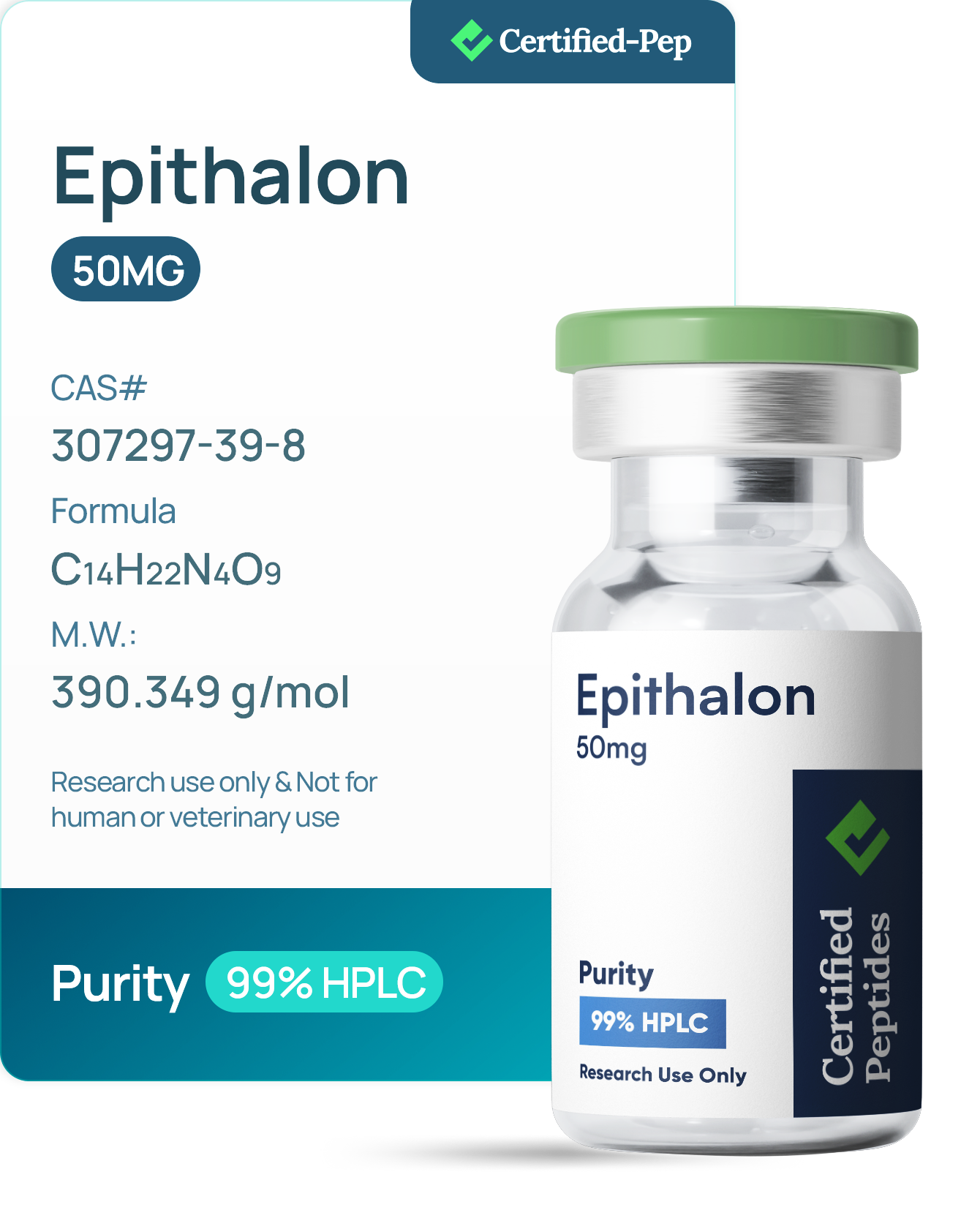
Certified-PEP offers Epithalon 50mg for laboratory research use, along with a 10mg vial. Researchers studying related short peptides can also browse the bioregulator shop. Products are made in the USA. An ISO/IEC 17025 third-party laboratory tests each lot for HPLC purity and identity, endotoxins, heavy metals and sterility, and every lot ships with a COA. Read the research purposes only policy before you order, and see how to store peptides for handling.
Research Epithalon
Benefits of Epithalon FAQ
What is epithalon?
A synthetic tetrapeptide of four amino acids, Ala-Glu-Asp-Gly, modeled on epithalamin from the pineal gland.
Does epitalon lengthen telomeres?
In cultured human cells, studies report telomerase activity and telomere elongation. It has not been shown to do so in people.
Does epitalon extend lifespan?
In one mouse study, mean lifespan did not change. Only the longest-lived tenth of animals lived longer.
Does epitalon help sleep?
Small studies of pineal peptides report a better melatonin rhythm. No controlled trial shows better sleep quality in people.
Is epitalon FDA approved?
No. It is not approved for any medical use.
Where can I see batch testing?
Batch reports are in the COA library, and the lab testing page lists the panel.
References
- Khavinson VKh, Bondarev IE, Butyugov AA. “Epithalon peptide induces telomerase activity and telomere elongation in human somatic cells.” Bull Exp Biol Med. 2003;135(6):590-592. PubMed
- Khavinson VKh et al. “Peptide promotes overcoming of the division limit in human somatic cell.” Bull Exp Biol Med. 2004;137(5):503-506. PubMed
- Anisimov VN et al. “Effect of Epitalon on biomarkers of aging, life span and spontaneous tumor incidence in female Swiss-derived SHR mice.” Biogerontology. 2003;4(4):193-202. PubMed
- Korkushko OV et al. “Normalizing effect of the pineal gland peptides on the daily melatonin rhythm in old monkeys and elderly people.” Adv Gerontol. 2007;20(1):74-85. PubMed
- Khavinson VKh, Morozov VG. “Peptides of pineal gland and thymus prolong human life.” Neuro Endocrinol Lett. 2003;24(3-4):233-240. PubMed
- Korkushko OV et al. “Geroprotective effect of epithalamin (pineal gland peptide preparation) in elderly subjects with accelerated aging.” Bull Exp Biol Med. 2011;151(3):366-369. PubMed
- Al-dulaimi et al. Epitalon and telomere extension in normal and cancer cell lines. Biogerontology. 2025. doi:10.1007/s10522-025-10315-x
- Anisimov VN, Khavinson VKh. “Peptide bioregulation of aging: results and prospects.” Biogerontology. 2010;11(2):139-149. PubMed
Research use only
Certified-PEP products are sold for laboratory research only. They are not drugs, foods, cosmetics or dietary supplements, and they are not for human or veterinary use. Nothing in this article describes effects in people or offers guidance for use in people.